If you’ve bought or built in one of Toowoomba’s newer estates — out at Highfields, around Glenvale, or any of the fresh developments on the city’s edge — your roof is the last thing you’re worrying about. It’s brand new. It’s under warranty. What could possibly need checking?
More than people think. A near-new roof can still have problems, and the time to catch them is while the builder’s warranty still covers them. Leave it too long and a defect that the builder would have fixed for free becomes a repair you’re paying for. Here’s why a new roof still needs a look, what tends to go wrong on builder-grade roofs, and how to use your warranty window properly.
Quick answer: Even a brand-new Toowoomba roof can hide builder-grade defects — loose or under-driven fixings, poor flashing detail, blocked or wrongly-falling gutters, missing sarking, and debris left in the roof space. The key is to inspect and document any issues while the builder’s warranty still applies, because a defect fixed free under warranty becomes your bill once it lapses. Have an independent roofer check it within the warranty window and report problems to the builder in writing.
Why a brand-new roof still needs checking
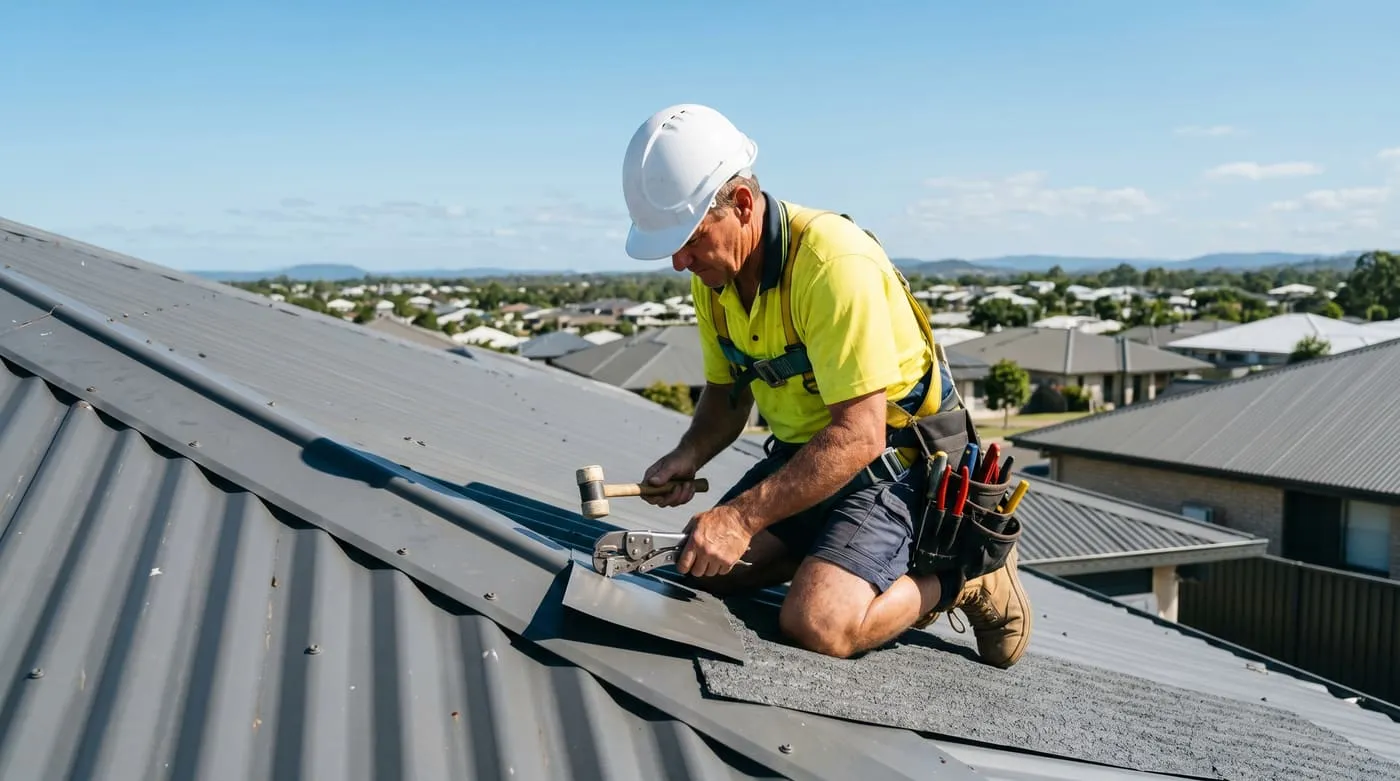
A new roof being defect-free isn’t a given — it depends entirely on how carefully it was installed. New estates get built fast and at volume. Crews move quickly, multiple trades work the same roof (roofers, plumbers running flues, solar installers, antenna fitters), and the finishing details are exactly where a rushed job shows up later.
The roof sheets themselves are rarely the problem on a new home. It’s the details around them — the flashings, the ridge capping, the penetrations, the fixings — that get skimped or rushed when a crew is pushing to the next house. Those details often look fine from the ground on handover day and only show themselves a season or two later when the first big Toowoomba storm finds the weak spot.
So the issue isn’t that builders build bad roofs. It’s that small finishing defects are easy to miss at handover, cheap to fix while they’re under warranty, and expensive to ignore.
Common builder-grade roof defects
These are the ones that turn up most often on newer homes:
Flashing gaps and poor flashing work
Flashings are the metal that seals the joins — where the roof meets a wall, around the chimney or flue, around skylights, in the valleys. Rushed flashing is the number-one source of leaks on new homes. We see gaps, flashings that aren’t lapped or sealed properly, and flashings that were cut short to save a few minutes. Water finds these the moment wind drives the rain sideways, which on the Downs is most storms.
Loose or poorly bedded ridge capping
On a tiled new build, the ridge caps along the top of the roof need to be bedded and pointed properly. On a metal roof, the ridge capping needs to be fixed down correctly. We regularly find ridge capping on near-new roofs that’s been done in a hurry — under-fixed, poorly bedded, or already lifting at the ends. Toowoomba and Highfields both cop strong winds off the range, and loose capping is exactly what the wind grabs first.
Storm-loosened and under-fixed sheets
Metal roof sheets need the right number of screws in the right places. A sheet that’s been under-fixed will sit fine in calm weather and then rattle, lift or work loose in a big wind. After the first serious storm in a new estate, loosened sheets and lifted edges are a common call — and on a roof that’s only a couple of years old, that’s usually a fixing job that should never have been needed.
Penetrations done by other trades
The roofer often isn’t the last person on the roof. Solar installers, plumbers running flues and vents, and antenna fitters all put holes in it afterwards — and the sealing around those penetrations is a frequent leak source. A flue boot that wasn’t sealed properly or a solar mount screwed straight through a sheet without a proper seal will leak, and it’ll often get blamed on the roof when it was a different trade.
Blocked or poorly graded gutters
New gutters can be installed with poor fall, or left full of construction debris — offcuts, screws, sand and silt from the build. That shows up as overflowing gutters in the first heavy rain. It’s a quick fix, but worth catching.
The builder-warranty window — and why timing matters
Newer homes come with builder’s warranty cover, and roofing defects generally fall within it. The exact terms depend on your build contract and the relevant Queensland home-warranty arrangements, so check your own paperwork rather than assuming — but the practical point is the same for everyone: the cover doesn’t last forever, and the clock is already running.
That’s the bit people get caught by. A flashing gap or some loose capping that would have been the builder’s responsibility to fix at no cost becomes your repair bill once the window closes. So the move is simple: get the roof properly looked over while you’re still well inside the warranty period, not when you finally notice a stain on the ceiling years later.
It’s the same logic behind getting a good roofer in general — knowing what to look for and what to ask. Our guide on the questions to ask a roofer before hiring is worth a read whether you’re vetting your original builder’s work or getting an independent set of eyes on it.
Your new-build roof checklist
You can do the first pass of this yourself from the ground and from inside the roof space — no need to climb up. Here’s what to look at:
From inside the house and roof space:
- Check ceilings and cornices for any staining, especially after rain — even a faint mark points to water getting in somewhere.
- Get into the manhole and look at the underside of the roof on a dry day, then again after rain if you can. Look for damp sarking, water marks on the timber, or daylight where there shouldn’t be any.
- Around any downlights or ceiling penetrations, check for dampness.
From the ground, looking up:
- Scan the ridge line for capping that’s lifted, sitting unevenly, or has visible gaps.
- Look along the sheet or tile lines for anything that’s lifted, displaced or sitting proud after a windy day.
- Check the gutters for sagging, poor fall (water sitting in them long after rain) or overflow stains down the fascia.
- Look at where the roof meets walls, the flue and any skylights — flashing that’s obviously short, gapped or peeling is a red flag.
Worth getting a professional eye on:
- Anything you can’t safely see from the ground or the manhole — the actual flashing, capping and penetration details up close.
- Any roof that’s had solar, a flue or an antenna added after handover.
If anything on this list looks off, that’s the trigger to act while the warranty’s still live.
Document everything — it’s what makes a warranty claim stick
A warranty is only as good as your ability to prove the defect. Builders and warranty schemes deal in evidence, not “it looks a bit dodgy.” So as you go through the checklist, build a simple record:
- Photograph everything. Date-stamped photos of the gap, the lifted capping, the ceiling stain — close up and in context. Take them as soon as you spot the issue.
- Note when it appeared. “Ceiling stain showed up after the storm on [date]” is far stronger than a vague complaint.
- Keep your build and handover paperwork together so you can point to dates and cover terms.
- Report defects in writing. A dated email to the builder creates a record that you raised it inside the window — which matters if there’s any argument later.
If you’d rather have it done properly, an independent roof inspection gives you a written, photographed assessment you can hand straight to the builder. That takes the “he said, she said” out of it.
When it’s not a warranty job
Not everything on a near-new roof is the builder’s problem. Storm damage, for instance, is usually an insurance matter rather than a warranty one — if a hailstorm dents your two-year-old roof, that’s a storm and insurance repair, not a defect claim. And genuine wear-and-tear maintenance is on you, though there shouldn’t be much of that on a roof this young.
The line is roughly: was it a defect in how it was built and installed (warranty), did the weather do it (insurance), or is it normal upkeep (yours)? A good roofer can tell you which bucket a problem falls into, and sometimes it’s a mix. Either way, a leak is a leak — if water’s getting in, our leaking roof repairs and general roof repairs cover the fix whether the builder ends up paying or not.
Common questions
My house is only two years old — surely the roof is fine? Usually mostly fine, but two years is exactly when rushed finishing details start showing up. The first couple of storm seasons find the weak flashings and the under-fixed capping. That’s the ideal time to check, while it’s still under warranty.
Who’s responsible if my new roof leaks — me or the builder? If it’s a defect in how it was built and installed, it’s generally the builder’s responsibility within the warranty window. If the weather caused it, it’s likely an insurance matter. If it’s after the window closed, it’s probably yours. Documenting when and how the problem appeared is what decides it.
The leak is around my solar panels — is that the roof’s fault? Often not directly. Solar installers, plumbers and antenna fitters put holes in the roof after the roofer’s gone, and the sealing around those penetrations is a common leak source. Worth getting it pinned down, because who’s responsible depends on who made the hole.
Should I get an independent inspection or just ask the builder? Both have a place, but an independent, photographed inspection gives you neutral evidence to hand the builder — which makes a defect much harder to wave away.
I’m in a new Highfields/Glenvale estate — is this really worth it? Those fast-growth estates are exactly where volume building and rushed finishing show up. A quick check now, while everything’s under warranty, is cheap insurance against paying for a builder’s shortcut later.
Don’t wait for the ceiling stain
A new roof in Toowoomba, Highfields or Glenvale isn’t automatically a perfect roof — it’s a roof whose finishing details are worth checking while someone else is still on the hook to fix them. Run the checklist, document anything that looks off, report it in writing, and act inside your warranty window.
We work right across Toowoomba, Highfields and Glenvale and we see plenty of near-new roofs with small builder-grade defects. Get in touch for an honest inspection — we’ll tell you what’s a warranty issue, what’s a genuine repair, and what’s perfectly fine and not worth worrying about.