
That brown stain creeping across the ceiling is your roof asking for help. And the longer you leave it, the more it costs — because the leak itself is rarely the expensive part. The expensive part is the rotten timber, the soaked insulation and the collapsed plasterboard you’re paying for as well as the leak by the time you finally call someone.
We stop leaks properly. Not a smear of sealant where the stain is — a real diagnosis and a lasting fix.
Quick answer: A leaking roof repair is the process of tracing a leak back to where water actually enters the roof — not just where the stain shows — and fixing the cause. That means inspecting the roof, flashings, valleys and ridge lines, using controlled water testing to pinpoint the entry point even on a dry day, then replacing broken tiles, re-bedding and re-pointing ridge capping, repairing rusted flashings or valley irons, or re-sealing penetrations, and testing that the fix holds. Caught early, a leak is one of the cheapest jobs a roofer does.
Why most leak “repairs” don’t hold
Here’s the trap. Water gets into a roof through a tiny gap up high, then runs along the underside of the roof — across battens, down beams, along the sarking — before it drips through your ceiling, often metres from where it actually got in. So when someone seals the spot directly above the stain, they’ve sealed the wrong place. Next storm, the leak’s back.
We don’t guess. We trace the water back to where it genuinely enters and fix that. It’s the difference between a repair that holds for years and one that fails next week — and it’s exactly why a proper leak repair is worth more than a cheap patch that’s back at the first heavy rain.
What causes most roof leaks around Toowoomba
Leaks rarely come out of nowhere — they almost always trace back to a handful of usual suspects, and knowing them is half of finding them fast. The most common causes we deal with across Toowoomba and the Downs are cracked ridge-cap pointing (the number-one culprit on tile roofs, thanks to our frost-and-heat cycle), broken or slipped tiles, rusted or failed flashings around chimneys, walls and roof junctions, deteriorated valley irons, and perished sealant around whirlybirds, vents and skylights. Storms and hail add their own damage on top, and older or never-maintained roofs are far more prone to the lot.
The tricky part is that the leak you see inside is almost never directly below the fault. Water gets in up high and travels along battens, beams and sarking before it finally drips through the ceiling — often metres away. That’s why chasing the source properly, rather than sealing the spot under the stain, is the whole game with leak repairs.
How we find your leak
- A careful inspection of the roof, flashings, valleys, penetrations and ridge lines
- Checking the roof cavity from inside where access allows, following the water trail back up
- Controlled water testing to pinpoint the entry point — even on a dry day
- Identifying the actual cause, then showing you with photos
Then we fix the cause
Depending on what we find, that might mean:
- Replacing cracked, slipped or broken tiles
- Re-bedding and re-pointing failed ridge capping
- Repairing or replacing rusted flashing and valley irons
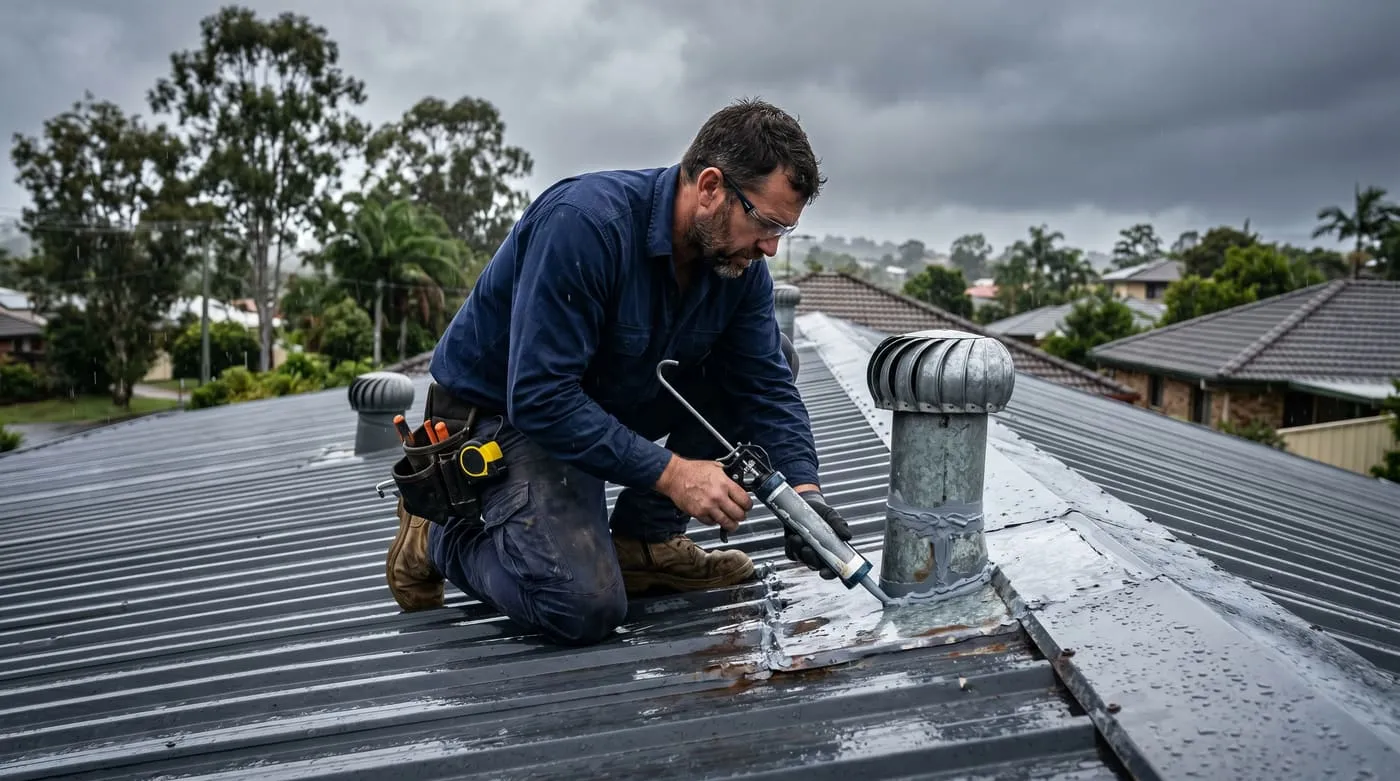
- Sealing around whirlybirds, vents, pipes and skylights
- Repairing or replacing damaged metal sheets
Then we test it to make sure it’s watertight, and we back the repair in writing.
The materials and methods we use
Finding a leak is half detective work, half experience — so we use a combination of careful visual inspection, checking the roof cavity from inside where we can get access, and controlled water testing to pinpoint the entry point, even on a dry day. Once we know where the water’s really getting in, the fix uses the right material for the cause, not a one-size-fits-all blob of silicone:
- Broken tiles are replaced with matching tiles and re-bedded, not just sealed over
- Failed ridge pointing is re-bedded in fresh mortar and re-pointed with a flexible compound that won’t crack straight back
- Rusted or failed flashings and valley irons are repaired or replaced in quality, properly profiled material
- Penetrations — around whirlybirds, vents, pipes and skylights — are re-flashed and sealed with roofing-grade, UV-stable sealants
- Damaged metal sheets are repaired or replaced and the cause of the rust treated so it doesn’t return
The point is that we fix the actual fault with the proper material, then test that it holds — which is what makes a repair last rather than reappear next storm.
Transparency: what a leak repair costs
Leak repairs vary a lot — a single cracked tile is a small job; chasing a hidden leak across a large or steep roof takes more time. So rather than a vague figure over the phone, we find the source, show you the cause with photos, and give you a fixed price before we start. Because we carry common materials on the truck, many leaks are sorted in a single visit. If, once we’re up there, the leak turns out to be a symptom of a roof that’s genuinely reached the end of its life, we’ll tell you honestly and talk through a restoration or replacement rather than charging you for a repair that won’t hold. Every repair is backed by our written workmanship guarantee — if it’s our fix and it leaks, we’re back.
Don’t wait for the next storm
If you’ve got an active leak, get a bucket under it, pull wet insulation away from the ceiling if you can do so safely, and give us a call. Leaks are a priority job for us and we’ll get to you as fast as we can.
If the leak turns out to be a symptom of a roof that’s reached the end of its life, we’ll tell you honestly and walk you through a restoration or replacement — but most leaks are a straightforward, affordable fix when they’re caught in time.
That last point is the whole message: leaks only get more expensive the longer they’re left. The water keeps finding timber, insulation and plasterboard, and what could have been a quick repair becomes a repair plus a ceiling plus mould remediation. Catch it early and a leak is one of the cheapest jobs we do. That’s why, if you’ve got so much as a suspicious stain, it’s worth a call sooner rather than later.