
A water stain on the ceiling is one of those problems that’s easy to ignore for a while and very expensive to ignore for too long. By the time water shows up inside, it’s usually been getting into the roof space for a while, quietly soaking insulation and timber. The good news is that most roof leaks come down to a handful of common causes, and once you know what they are, a leak stops feeling like a mystery. Here’s what’s most likely behind yours and how a roofer tracks it down and fixes it.
Quick answer: The most common causes of roof leaks are failed or poorly installed flashings (around chimneys, vents, valleys and skylights), cracked or slipped tiles, rusted or punctured metal sheets, perished sealant and loose fixings, blocked gutters causing overflow back under the roof, and cracked ridge-cap pointing. The leak inside is rarely directly below the entry point — water travels along battens and rafters first — so finding the true source is the key step. Most leaks are repairable once the entry point is correctly traced.
The first thing to understand: the leak isn’t where the stain is
This trips up almost everyone. Water rarely drips straight down from the hole that let it in. It runs along the underside of the roof, down a batten or a rafter, across the top of a ceiling, and finally drops through at the lowest point it reaches — which can be metres away from the actual entry point. So the stain on your ceiling tells you where the water landed, not where it got in.
That’s why chasing a leak properly takes experience. A good leaking roof repair starts with finding the true source, not just patching the spot under the stain. Patch the wrong place and the leak keeps going while you think it’s fixed — which is how a small problem turns into a rotten ceiling.
The common causes of roof leaks
Cracked or slipped tiles
On a tile roof, this is the classic. A single cracked tile — from hail, foot traffic or a falling branch — lets water straight through to the sarking below, and from there it finds a path inside. Slipped tiles leave a gap that does the same. The fix is straightforward once it’s found: replace the broken tiles and reseat any that have slipped. The hard part is spotting which tile out of hundreds is the culprit.
Failed ridge capping
Cracked, crumbling mortar on the ridge caps is one of the most common leak sources on the Downs. The pointing breaks down over years of the roof heating and cooling, opening hairline gaps along the ridges and hips that let water track straight in. The fix is re-bedding and re-pointing the affected caps with a flexible compound — the same ridge-cap work that’s central to a tile restoration.
Rusted or lifted flashings
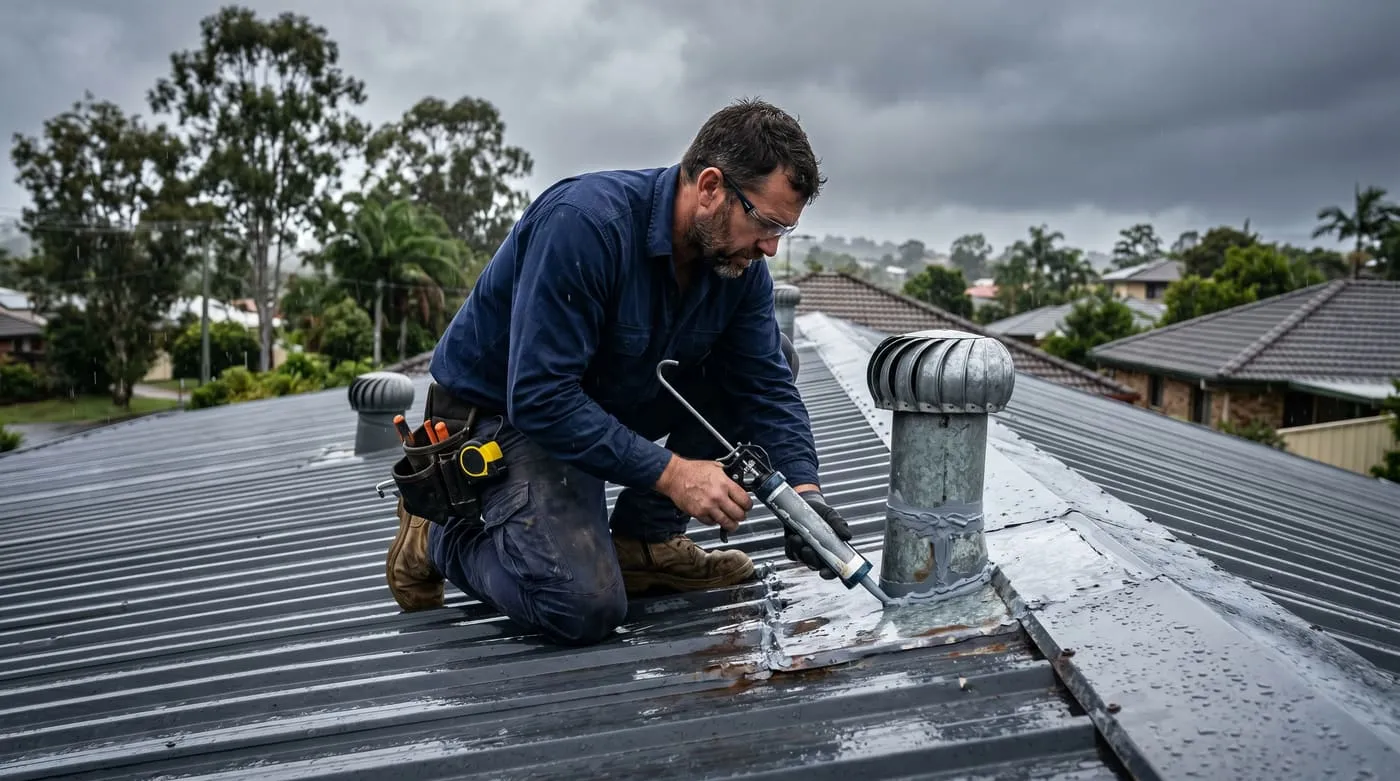
Flashings are the metal pieces that seal the joins — around chimneys, vents, skylights, and anywhere the roof meets a wall. They’re a hugely common leak point because they take a lot of weather and movement. When flashing rusts through or lifts at the edge, water runs in behind it. The fix is resealing, refixing or replacing the flashing, and it’s one of the most frequent repairs we do.
Loose or backed-out screws on metal roofs
Metal roofs are fixed with screws, and over years of expansion and contraction — pronounced up here on the range — those screws can work loose or back out, and their rubber washers perish. Each one becomes a tiny hole. The fix is replacing the failed fixings and their washers, sometimes across a whole roof if they’ve all reached the same age.
Blocked or overflowing gutters and valleys
Sometimes the “roof leak” is really a drainage problem. Blocked gutters and valleys can’t carry a Darling Downs downpour, so water backs up under the roof edge and into the eaves or the cavity. The fix here is clearing and sometimes upgrading the gutters — and the prevention is keeping them clear, especially on leafy streets.
Failed or aged roof coating
On a tired roof, the protective coating eventually fails — it chalks, cracks and lets moisture through across the surface rather than at one point. This shows up as a roof that’s “leaking everywhere a bit” rather than one obvious drip. The fix here is usually a full roof restoration rather than a spot repair, because you’re dealing with general wear, not a single fault.
Storm and hail damage
After a big storm, leaks often appear that weren’t there before — displaced sheets, cracked tiles, dented and split metal, lifted flashings. Storm leaks can be sudden and dramatic. These are usually an insurance matter, and the priority is an emergency make-safe to stop further damage before the permanent repair.
How a roofer finds the real source
Tracking a leak is detective work. A roofer starts inside, in the roof space if it’s accessible, looking for the trail — water staining on the underside of the sarking or the timbers, following the run uphill from where it drips to where it enters. Then they get up top and inspect the likely entry points above that area: the nearest ridge caps, flashings, tiles, valleys and fixings. On a metal roof they’ll check the high side of the suspect area, because water tracks downhill from the entry point.
Sometimes the cause is obvious once you’re up there — an obviously cracked tile, a flashing peeled back, a screw missing. Other times it takes a hose test, deliberately wetting sections of the roof in sequence while someone watches inside for the water to appear, to pin down an elusive leak. The point is that finding the source is most of the job; the actual repair is often quick once you know where to aim it.
Why you shouldn’t just patch it yourself
It’s tempting to climb up with a tube of sealant and smear it over the spot that looks wrong. We get called to plenty of leaks that have been “fixed” this way three or four times and are still leaking, because the sealant went on the wrong spot — remember, the stain isn’t above the entry point. Worse, a DIY patch can trap water behind it and make the real problem harder to find later. And a roof is a genuinely dangerous place to be poking around; falls cause serious injuries every year. Leave the climbing, and the leak-tracing, to someone with the gear, the training and the insurance.
Catch it early — it’s the cheap way
The reason to act on a leak quickly is the same reason maintenance pays off: water damage compounds. A leak that’s caught when the stain first appears is usually a cheap, contained repair — a tile, some pointing, a flashing. Left to run, the same leak soaks insulation (which then stops working), rots timber battens and rafters, stains and eventually brings down sections of ceiling, and creates the damp conditions mould thrives in. What was a small repair becomes a ceiling replacement and a mould problem, many times the cost.
Keeping an eye out for the early warning signs is the cheapest roofing habit there is. Our season-by-season roof maintenance checklist covers what to watch for and when, so a leak gets caught while it’s still a five-minute fix.
Common questions about roof leaks
My ceiling stain dried up — is the leak fixed? Not necessarily. A stain dries out between rain, but the fault is still there and will leak again in the next downpour. A dried stain that came back is a clear sign the entry point hasn’t been found and fixed. Don’t take a dry day as the all-clear.
Why does my roof only leak in heavy rain, not light rain? Some faults only let water in when there’s enough volume to back up, overflow a valley, or get driven sideways by wind. A leak that’s intermittent and tied to heavy or wind-driven rain is common and real — it just needs the right conditions to show, which can make it trickier to trace.
Can a leak come from condensation rather than rain? Yes. On metal roofs especially, warm moist air hitting cold steel forms condensation on the underside, which drips onto insulation and can mimic a leak. The fix there is often better roof ventilation rather than a patch, because there’s no actual hole to seal.
How urgent is a small leak? More urgent than it looks. Even a slow leak is wetting timber and insulation every time it rains, and the damage adds up out of sight. The cheapest time to deal with any leak is now, while it’s small — waiting only ever makes the repair bigger.
Tile versus metal: where leaks tend to start
The type of roof you’ve got shifts the odds toward different causes, which helps when you’re trying to make sense of a leak. On tile roofs, the usual suspects are cracked or slipped tiles and failed ridge-cap pointing. The ridges and hips are the first place to look, because that’s where most tile leaks begin — the mortar there cops the most movement and is the first thing to break down. Cracked tiles run a close second, especially after hail or anyone walking the roof. Both are common on the older tile roofs across the established Toowoomba suburbs, and both are fixable jobs once the offending tile or cap is found.
On metal roofs, leaks cluster around the fixings, the flashings and the laps. Backed-out screws with perished washers are the classic, each one a pinhole that lets water in during driven rain. Lifted or rusted flashings around penetrations and wall junctions are the other big one. Because metal roofs are common on the newer estates and rural Darling Downs properties, these are the leaks we see most out that way. Knowing your roof type narrows the search before anyone even gets up there — and it’s why telling a roofer what you’ve got over the phone helps them turn up ready for the likely culprit.
Get the leak found and fixed properly
A leak is one of those problems that rewards acting early and punishes putting it off. If you’ve got a stain, a drip or a damp patch, the smart move is to have someone trace it to the real source and fix that, rather than guessing. We chase down leaks across Toowoomba and the wider Darling Downs, and we’ll show you photos of what we find so you know exactly what was wrong and what we did about it. Get in touch and we’ll get you watertight before the next big rain.