
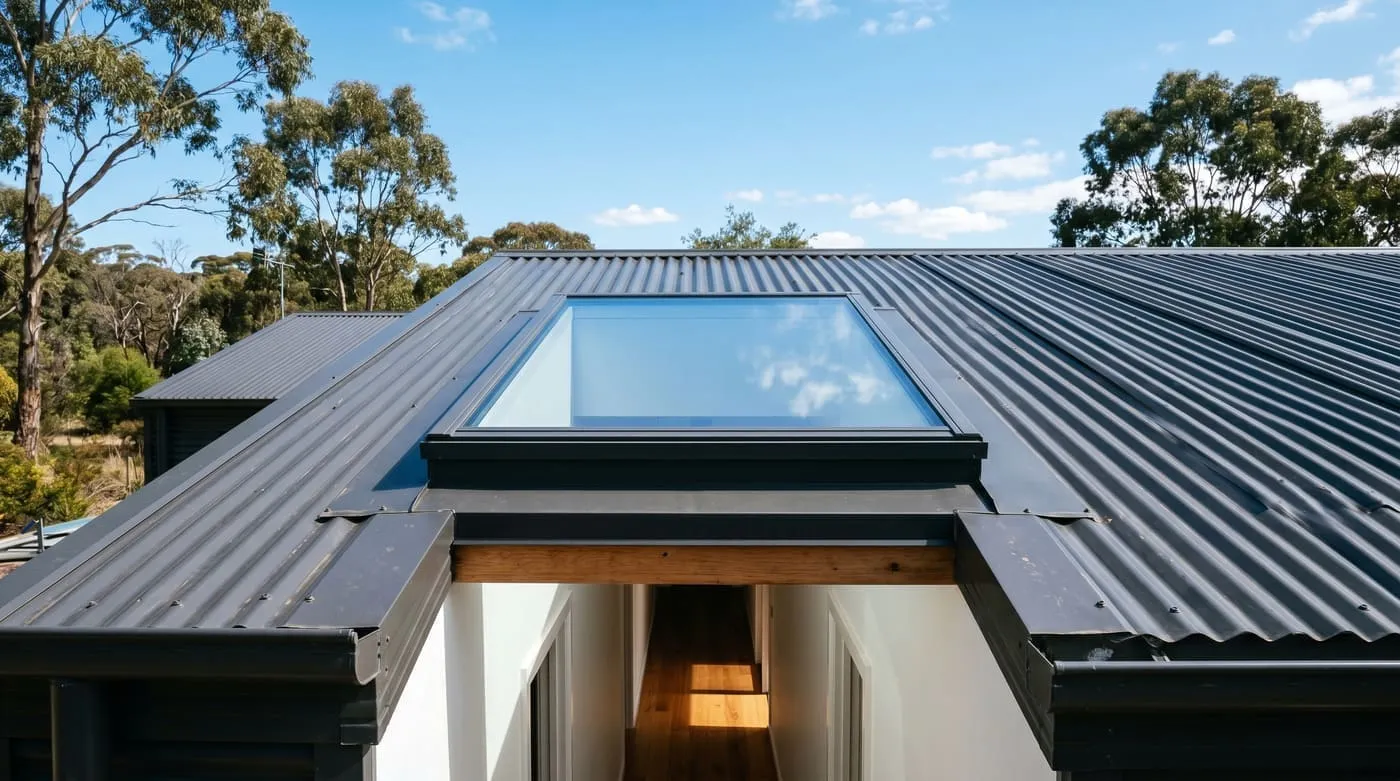
Roofing a house in a Toowoomba street and roofing an acreage or farm property out on the Downs are two different jobs. The materials might be the same, but the scale, the access, the gutter runs and what the roof is actually protecting all change once you head out past the edge of town. If you’re on a block at Gatton, Oakey, Pittsworth, Dalby or Allora — or anywhere with a homestead and a few sheds — here’s what rural roofing really involves and what to keep on top of.
Quick answer: Rural and acreage roofing on the Darling Downs differs from suburban work because of scale and exposure: large shed and homestead roofs, long gutter runs, rainwater-tank catchment that has to stay clean, more wind and dust exposure on open blocks, and harder access for trucks and crews. The priorities are durable metal (Colorbond or Zincalume for sheds), correctly sized gutters and downpipes for heavy storm runoff, secure wind-region fixings, and keeping tank-feeding catchment surfaces sound and clear.
Why rural roofing is its own thing
On a quarter-acre block in town, the roof is the house roof and that’s mostly it. On acreage and farms, the “roof” is usually a collection of buildings: the homestead, machinery and hay sheds, workshops, the dairy or packing shed, carports and stables. Each has a different job, a different age and a different level of exposure — and out on the open plains there’s often nothing between them and the weather.
That changes the priorities. It’s not just “keep the house dry.” It’s “keep the gear, the feed, the stock and the water supply protected too” — and do it across a lot more roof area than a town home, often with awkward access and long distances between buildings.
Big shed and machinery roofs
The biggest roof on most rural properties isn’t the house — it’s the shed. And those shed roofs earn their keep.
A machinery or hay shed roof is protecting serious value: tractors, headers, sprayers, tools and stored hay or grain. A leak you’d shrug at on a carport becomes a real problem when it’s dripping onto a header or soaking a stack of hay. Rust streaks down a shed wall are usually the first warning that the old galvanised sheets are giving up, and once steel starts rusting at the laps and fixings it keeps going.
The common rural shed issues we see:
- Old galv steel rusting out at the edges, laps and around the fixings — typical on sheds that have been up for decades.
- Wind-lifted and rattling sheets where fixings have worked loose, which the open-plains wind around Oakey, Dalby and Pittsworth finds quickly.
- Spreading flashings and ridge gaps that let wind-driven rain and dust in.
- Undersized or clapped-out gutters that overflow into the shed in heavy rain.
For a sound shed, re-screwing, re-flashing and replacing a few rusted sheets keeps it going. For one that’s past it, a full re-roof in bare Zincalume is usually the sensible, cost-effective call on a working shed — it’s durable, long-lasting and you’re not paying for colour you don’t need. Our specialty roofing and re-roofing services cover the larger and odder structures that fall outside a standard house re-roof.
Homestead roofs
The house roof on a rural block has its own character. A lot of Downs homesteads are older — Queenslanders, weatherboard homes and brick-and-tile farmhouses — and many still wear original galv, ageing tile or a tired coating that’s copped decades of hard UV, frost and dust with no shade to soften it.
Out on exposed country, coatings break down faster, ridge-cap mortar cracks under the big day-night temperature swings, and there’s rarely a neighbour’s roofline or a row of trees to take the edge off the wind and sun. So homestead roofs often need attention sooner than a sheltered town roof of the same age. Depending on what’s there, that’s a restoration, a re-roof or a roof replacement — and on an older homestead, switching tired tile or rusty galv to Colorbond is a popular move for the lower weight and lower upkeep.
Rainwater catchment: your roof is your water supply
This is the part town homeowners never have to think about and rural owners can’t ignore. On most acreage and farm properties, the roof is the water supply. Rain that lands on the house and shed roofs runs into the tanks, and that’s the drinking, washing and stock water for the place. So the roof isn’t just shelter — it’s catchment infrastructure.
That changes a few things:
- Material matters for water quality. Colorbond and Zincalume are well suited to tank catchment. Old, rusting galv sheds rust and grit into the water, and a tired flaking coating can shed into the tank too. If your tank water’s been looking off, the roof feeding it is worth a look.
- Gutters and downpipes are part of the water system, not an afterthought. Leaf litter, dust and bird mess in the gutters all end up heading toward the tank if the first-flush and screening aren’t doing their job. Clean, well-falling gutters keep the catchment cleaner.
- You want to catch as much as you can. On a property where every tank-full counts through a dry spell, gutters that overflow and waste runoff in a downpour are throwing away water you need. Properly sized, well-maintained guttering keeps more of the rain in the tank.
Our gutters service covers replacement and upsizing where the existing run can’t keep up.
Long gutter runs and gutter sizing
Big rural buildings mean long gutter runs, and long runs bring their own problems. The longer the gutter, the more water it has to carry to a downpipe, and the more it matters that it’s sized right and falls correctly.
On a big shed in a Downs downpour, an undersized or poorly graded gutter simply can’t move the water fast enough — so it overflows over the front, sheeting down the wall and into the shed or wasting catchment that should be heading to the tank. We regularly see big shed roofs with gutters that were fine for a gentle shower but give up the moment a proper storm hits.
The fixes are usually about capacity and flow: wider gutters, more or larger downpipes spaced along the run, and correct fall so water actually gets to the outlets instead of sitting and overflowing. On long runs it’s also worth keeping leaf and dust build-up down, because any blockage on a long gutter backs water up fast.
Dust — the rural roof problem nobody warns you about
Out on the cropping and grazing country around Oakey, Dalby, Pittsworth and Gatton, dust is constant — off the paddocks, off the unsealed roads, off the next-door harvest. It settles on roofs and, more importantly, packs into gutters and downpipes.
Dust-clogged gutters are one of the most common rural jobs we see. Packed dust holds moisture against the metal (which speeds corrosion), blocks flow so gutters overflow, and contaminates the tank water on its way through. On a dusty property, gutters need clearing more often than a town roof would — it’s just part of the rhythm of looking after a rural roof, much like the broader seasonal maintenance checklist but with dust as the headline issue rather than leaves.
Access: the practical reality
Rural roofing has access challenges town jobs don’t. Buildings are spread out, so gear and materials have to be moved between them. Big shed roofs are large, high and steep, and getting safely up and across them takes the right equipment and a crew used to it. Soft or boggy ground after rain can make getting a truck or elevated platform alongside a building genuinely tricky.
None of this is a problem for a roofer who works rural regularly — it’s just the job. But it’s worth knowing it’s a factor, because it’s part of why a rural quote isn’t the same as a suburban one, and why you want someone who actually services the area rather than a town firm treating your block as an inconvenient out-of-town call. We run out to Gatton, Oakey, Pittsworth, Dalby and Allora and we’re set up for spread-out, awkward-access rural work.
Why farm-shed roofs matter more than people think
It’s easy to put the house roof first and let the sheds slide — but on a working property the sheds are protecting your livelihood. A leaking hay shed roof spoils feed. A leaking machinery shed lets rust into expensive gear and damp into tools. A failing dairy or packing shed roof can be a real operational headache. The cost of fixing the roof is almost always small next to the cost of what the roof is protecting.
That’s why we tell rural clients not to treat the sheds as second priority. A quick re-screw and re-flash on a sound shed, or a sensible Zincalume re-roof on one that’s past it, is cheap insurance against losing far more underneath.
Common questions
Do you actually come out to farms and acreage, or just town? We service rural properties right across the Downs — Gatton, Oakey, Pittsworth, Dalby, Allora and the country in between. Spread-out buildings and awkward access are normal for us, not a problem.
What’s the best roof for a big farm shed? For a working shed where looks don’t matter, bare Zincalume is hard to beat — durable, long-lasting and good value. If it’s a shed you want to look tidy or it feeds a rainwater tank, Colorbond is worth the small extra.
Will my roof affect my tank water quality? Yes. A rusting old galv roof or a flaking coating sheds into the tank. Sound Colorbond or Zincalume, with clean well-screened gutters and a working first-flush, gives you much cleaner catchment.
My shed gutters overflow every storm — what’s wrong? Usually they’re undersized, poorly graded, or clogged with dust and leaf litter — or all three. On long rural gutter runs the fix is often wider gutters with more downpipes and correct fall, plus keeping the dust build-up down.
How often should I clear gutters on a dusty property? More often than a town roof — dust packs in faster than leaves and it both blocks flow and holds moisture against the metal. Going into storm season and after any big dusty harvest are the times to check.
Look after the whole property
A rural roof is the house, the sheds, the gutters and the water supply all at once — and out on the open Downs it all takes a harder beating than a sheltered town roof. The smart approach is to keep the sound roofs maintained, re-roof the ones that are past it before they cost you what’s underneath, and treat the gutters as part of your water system rather than an afterthought.
We look after acreage and farm properties across the Darling Downs and understand what rural roofs need. Get in touch for a quote and we’ll come out, look over the house and the sheds, and tell you honestly what needs doing and what can wait.