Here’s a question with a slightly surprising answer: a Colorbond roof is factory-coated and designed not to need repainting for a very long time — often 15 to 20 years or more. Unlike a tile roof, you’re not on a regular repaint schedule. But there are good reasons you might recoat one, and signs that tell you it’s time.
Quick answer: A Colorbond roof doesn’t need repainting on a fixed schedule — its baked-on factory finish is designed to last 15 to 20 years or more without a recoat. You repaint when the colour has visibly faded or chalked, the finish is worn, or you simply want a new colour, rather than at set intervals. This is one of Colorbond’s biggest advantages over tile, which needs periodic resealing and recoating to stay weatherproof.
Colorbond doesn’t need frequent repainting
The baked-on factory finish on Colorbond steel is durable and built for Australian conditions. For the first couple of decades, a wash now and then is usually all the colour needs. So if someone’s telling you a near-new Colorbond roof urgently needs repainting, be sceptical.
When repainting makes sense
Over time — typically the 15–20 year mark, sometimes longer inland — the factory finish does eventually fade, chalk and lose its protective edge. That’s when a recoat is worth it. Signs to watch for:
- Noticeable fading or a chalky residue when you rub the surface
- Patchy, uneven colour across the roof
- Surface rust starting to appear, especially at edges and fixings
- You simply want to change the colour
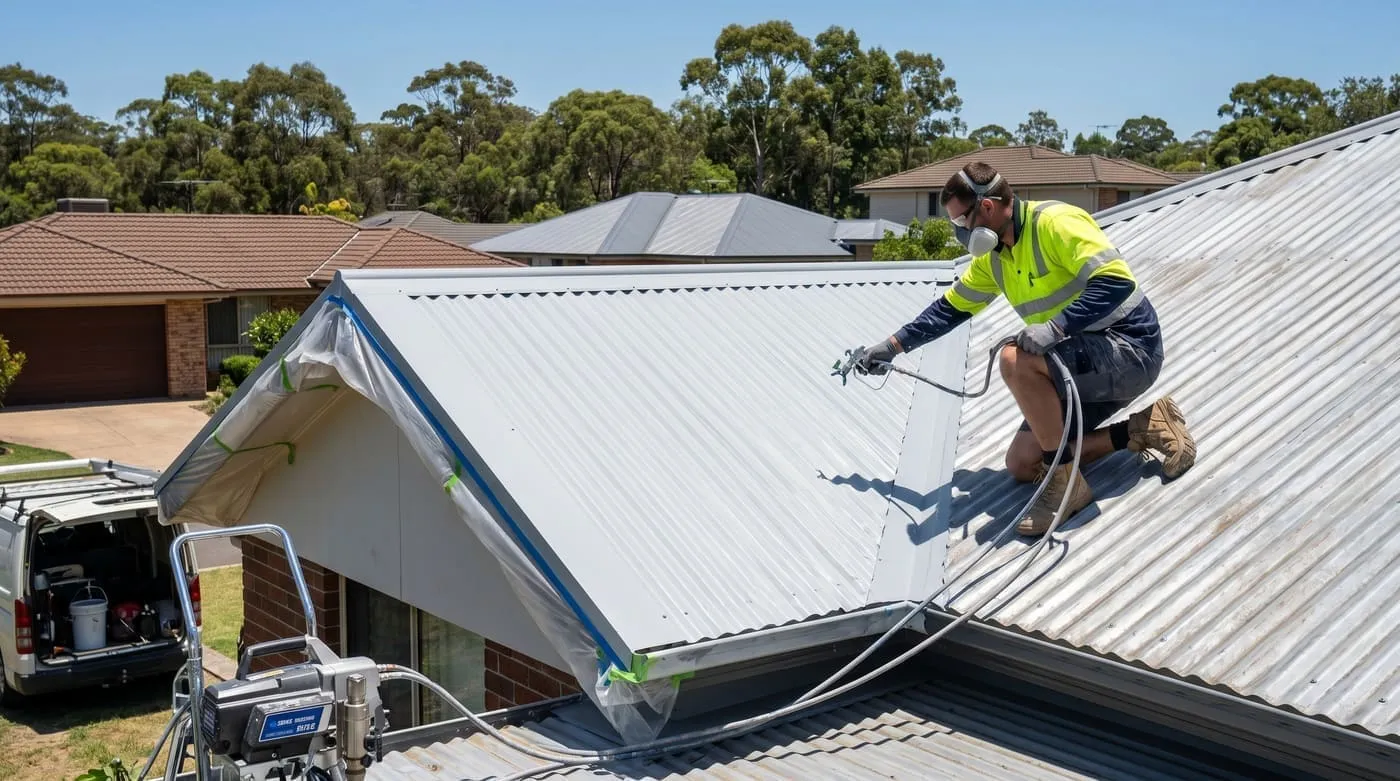
At that point, a professional roof painting job — proper prep, primer and quality membrane — refreshes the look and adds years of protection.
What “chalking” actually is
Chalking is the one most people haven’t heard of, so it’s worth explaining because it’s the clearest early signal that a finish is ageing. Over many years of UV exposure, the resin that binds the colour pigment slowly breaks down at the very surface. The pigment is left behind as a fine, loose powder. Run your hand across an old painted roof and you’ll come away with a faint coloured dust on your palm — that’s chalking.
A bit of chalking isn’t an emergency. It’s the coating telling you it’s done most of its working life. Left long enough, though, the protective film keeps thinning and you eventually expose the steel underneath to the weather. Catching a roof at the chalking stage, before any rust starts, is the ideal time to recoat — the prep is simpler and you’re protecting sound steel rather than repairing damaged steel.
Why the Darling Downs is harder on roofs than the coast
Inland conditions age a roof differently to the coast, and it cuts both ways. The good news: we’re well away from salt air, so coastal-style salt corrosion isn’t the constant threat it is in beachside suburbs. The tougher news: the Downs throws intense, high-UV summer sun, big day-to-night temperature swings, regular frosts up around Highfields and Crows Nest, and the odd serious hailstorm and dust event.
That constant expansion and contraction, plus relentless UV, is what slowly works on a coating over the decades. Roofs on exposed rural blocks around Oakey, Pittsworth and Gatton — full sun, no tree cover, wind-driven grit — generally weather faster than a sheltered roof in town. None of this changes the rough 15-to-20-year ballpark, but it’s why two roofs of the same age can be in noticeably different shape. The honest answer always comes from looking at your roof, not a calendar.
Don’t just paint over problems
If the roof’s also rusting or has other issues, painting alone isn’t the answer — those need treating first. On an older metal roof showing real wear, a full roof restoration (which includes repairs and rust treatment before coating) is often the better call than paint alone.
What a proper recoat actually involves
When a recoat is genuinely due, the work that goes in beforehand matters far more than the paint itself. A quality job on a metal roof generally runs through these steps:
- Inspection and repairs first. We check every sheet, lap, screw and flashing. Any minor repairs, loose fixings or failing flashings get sorted now, because no coating will hold over a problem underneath it.
- Rust treatment. Surface rust is wire-brushed or ground back and treated with a rust converter or primer so it doesn’t keep spreading beneath the new finish.
- A thorough clean. The whole roof is pressure-washed to strip off chalk, dirt, lichen and loose old coating. Paint will not bond to a dirty or chalky surface — this step is non-negotiable.
- Priming. Bare and treated areas get a suitable primer so the topcoat has something to grip.
- Membrane coats. Two coats of a quality roof membrane go on, ideally rolled or sprayed to an even thickness, with proper dry time between coats.
Skip the prep and you get a roof that looks great for a year and then peels. The reason a professional recoat costs what it does is almost entirely the prep — anyone can roll on paint.
DIY versus calling a roofer
We get asked whether you can just do it yourself with a tin from the hardware store. Honestly, for a roof, we’d steer you away from it. There’s the obvious safety issue — working at height on a pitched metal roof is genuinely dangerous and most serious DIY home injuries involve ladders and roofs. Beyond that, getting an even, properly bonded finish over a whole roof is harder than it looks, the right membranes aren’t always sold in small quantities, and you won’t have the gear to safely pressure-clean and prep at height. A patchy DIY coat can also make a later professional job more expensive because it has to be stripped back. If your roof is genuinely due, it’s worth getting it done once, properly.
Make it last longer
- Keep gutters clear so water and debris don’t sit against the steel
- Rinse off built-up dust and grime occasionally
- Address any minor repairs promptly
- Consider a heat-reflective coating at recoat time for summer comfort
- Trim back overhanging branches so leaves and sap don’t sit on the steel
A few questions we hear a lot
Is repainting the same as restoring? Not quite. Repainting is the coating part. A full roof restoration bundles the repairs, rust treatment, re-bedding of any ridge caps and then the recoat into one job. On a roof that only needs a colour refresh and is otherwise sound, painting is enough. On a tired roof, restoration is the better value because it fixes the underlying issues at the same time.
Can I just change the colour because I’m sick of it? Yes. Wanting a different look is a perfectly good reason to recoat, even if the existing finish is sound. A recoat is also a chance to go lighter for summer heat performance — worth a thought given our climate, and we cover the trade-offs in our guide to the best roof colour for a hot QLD climate.
How long does a recoat last? A properly prepped and coated metal roof should give you a good many years before it’s due again — broadly similar to the life you’d expect from a quality restoration. Keeping up with the basic maintenance above stretches it further.
Does it add value when selling? A fresh, even-coloured roof with no visible rust makes a strong first impression and signals the home’s been looked after. It won’t transform a valuation on its own, but a tired, rust-streaked roof absolutely puts buyers off, so a recoat at the right time is sensible presentation.
Tile roofs are a different story
It’s worth drawing the contrast, because a lot of confusion comes from people applying tile advice to metal. A painted tile roof — concrete tiles especially — really does sit on a much shorter repaint cycle, often around the ten-year mark, because the coating on a porous tile weathers faster than the baked-on finish of steel. So if a neighbour with a tile roof tells you they recoat every decade or so, that’s normal for them and no reason to panic about your near-new Colorbond. The two materials simply age on different timelines. If you’ve got tile rather than metal, our tile roof repairs page is the better starting point.
What it roughly costs and what drives the price
We won’t pin a firm figure on a recoat without seeing the roof, because honest pricing depends on what we find. As a rough, indicative guide, expect a metal roof recoat to land somewhere in the low-to-mid thousands for an average house, with a full restoration costing more because it bundles in the repairs and re-bedding. The things that move the number are:
- Roof size and pitch. Bigger and steeper means more material, more time and more safety setup.
- Access. A high-set Queenslander or a tight block is harder and slower to work safely than a simple low-set home.
- Condition. A roof with widespread rust or failing flashings needs far more prep than one that just needs a colour refresh.
- The coating system. A premium heat-reflective membrane costs more than a basic one but earns its keep through our summers.
For a fuller picture of restoration pricing locally, our roof restoration cost in Toowoomba guide breaks down the ranges. Always treat any figure online as indicative — the only accurate number comes from a proper look at your actual roof.
The bottom line
A Colorbond roof won’t need repainting for many years — but when the finish finally fades or rust appears, a proper recoat protects your investment and brings it back to life. Not sure if yours is due? Get a free inspection and we’ll give you the honest answer.