It’s not just an aesthetic choice — your roof colour genuinely affects how hot your home gets. In a climate like the Darling Downs, where summer is no joke, picking the right colour can mean a cooler house and lower cooling bills. Here’s how to choose well.
Quick answer: For a hot Queensland climate, a light-coloured roof is the best choice for keeping a home cool — light colours reflect more of the sun’s radiant heat, while dark roofs absorb it and pass it into the roof space. Lighter Colorbond colours with Thermatech solar-reflectance technology (such as Surfmist, Shale Grey or Dune) perform best, reflecting more summer heat than dark shades and cutting cooling costs.
Why colour matters
Dark colours absorb more of the sun’s radiant heat; light colours reflect more of it away. A dark roof can get significantly hotter than a light one in full sun, and a chunk of that heat radiates down into your roof space and through your ceilings. Choose a lighter colour and you keep more of that heat outside where it belongs.
The best colours for heat
For maximum heat reflection in our climate, lighter colours win — think Surfmist, Shale Grey, Dune, Paperbark and similar light tones. If you’re going with Colorbond, the lighter colours also come with Thermatech technology, which is engineered to reflect more heat than colour alone.
That said, mid-tones like Windspray or Bluegum strike a popular balance — cooler than dark colours, but not as stark as a near-white roof.
How much hotter does a dark roof actually get?
Sit a thermometer on a dark steel roof at midday in January and you’ll see why this matters. In direct Darling Downs summer sun, a dark roof surface can run far hotter than a light one — the gap between a near-white roof and a near-black roof can be tens of degrees at the surface. That heat doesn’t stay on the outside. Some of it conducts straight through the sheet, warms the air in your roof cavity, and then radiates down through the ceiling into your living spaces. By mid-afternoon your air conditioner is working against a roof space that’s turned into an oven.
Lighter colours flip that around. Less heat is absorbed in the first place, so there’s less to deal with before it ever reaches your insulation. On a stinking 38-degree day in Toowoomba or out on the flats around Oakey and Pittsworth, that head start is the difference between an air conditioner that cycles comfortably and one that runs flat out all afternoon.
What “solar reflectance” really means
You’ll see the term solar reflectance (sometimes called solar absorptance, which is the flip side) thrown around in roofing brochures. It’s just a measure of how much of the sun’s energy a surface bounces back versus soaks up. A high-reflectance colour throws most of the sun’s heat back at the sky; a low-reflectance colour holds onto it.
This is where Colorbond’s Thermatech matters. The same colour name can be engineered to reflect more heat than an older equivalent — so a modern light Colorbond sheet outperforms an old painted roof of the same shade. It won’t turn a dark colour into a light one, but within any given colour it squeezes out extra reflectance. If summer comfort is your priority, ask specifically about the reflectance of the colours you’re shortlisting rather than just judging by eye.
But heat isn’t the only factor
Roof colour is also about looks and street appeal, and a near-white roof doesn’t suit every home. Dark, dramatic roofs (Monument, Basalt, Night Sky) look fantastic on modern homes — they just run hotter. The good news is that with proper insulation and roof ventilation, you can choose a darker colour and still keep the house comfortable; the colour just does less of the heavy lifting.
It’s a system, not just a colour
The best result comes from combining a sensible colour with:
- Quality insulation to slow heat transfer
- Ventilation to flush hot air out of the roof space
- A heat-reflective coating if you’re painting or restoring an existing roof
Get the system right and you’ve got a noticeably cooler home through summer.
Don’t forget winter on the Downs
Here’s something a lot of coastal roofing advice skips: Toowoomba and the higher parts of the Darling Downs get genuinely cold winters. Frosts are normal up around Crows Nest and Highfields, and overnight temperatures drop well below what you’d see closer to Brisbane. A near-white, ultra-reflective roof that’s brilliant in January gives up a little of its passive solar warmth in July.
For most homes this is a minor trade-off, and you should still prioritise summer performance because that’s where your biggest energy spend and discomfort sits. But it’s a fair reason that a sensible mid-tone is so popular on the Downs — it reflects most of the summer heat while not being aggressively cold-leaning in winter. If you run gas or reverse-cycle heating through winter anyway, lean lighter for the summer win. The point is to choose with both seasons in mind, not just the hot months.
Matching colour to your house and street
The “best” heat colour is worthless if you hate looking at it, so balance performance with how the colour sits on your actual home. A few things worth weighing up:
What’s around you? On an established street where most roofs are a particular tone, a wildly different colour can stick out. That’s not always bad, but it’s worth a thought, especially if you’re thinking about resale.
What colour are your walls, gutters and fascia? Roof colour has to live alongside your brickwork, render or weatherboard, your gutters and your window frames. Light roofs tend to suit lighter, contemporary palettes; mid greys are forgiving and go with almost anything; darker roofs pop against light walls but amplify the heat issue.
How much of the roof can you actually see? On a low-set home with a steep pitch, the roof is a big part of the look. On a high-set Queenslander where you mostly see the underside and the verandah, colour matters less visually — so you can chase heat performance more freely.
What does the body corporate or covenant allow? Some newer estates around Highfields and the southern fringes of Toowoomba have colour rules. Check before you fall in love with a shade.
Painting an existing roof versus a new one
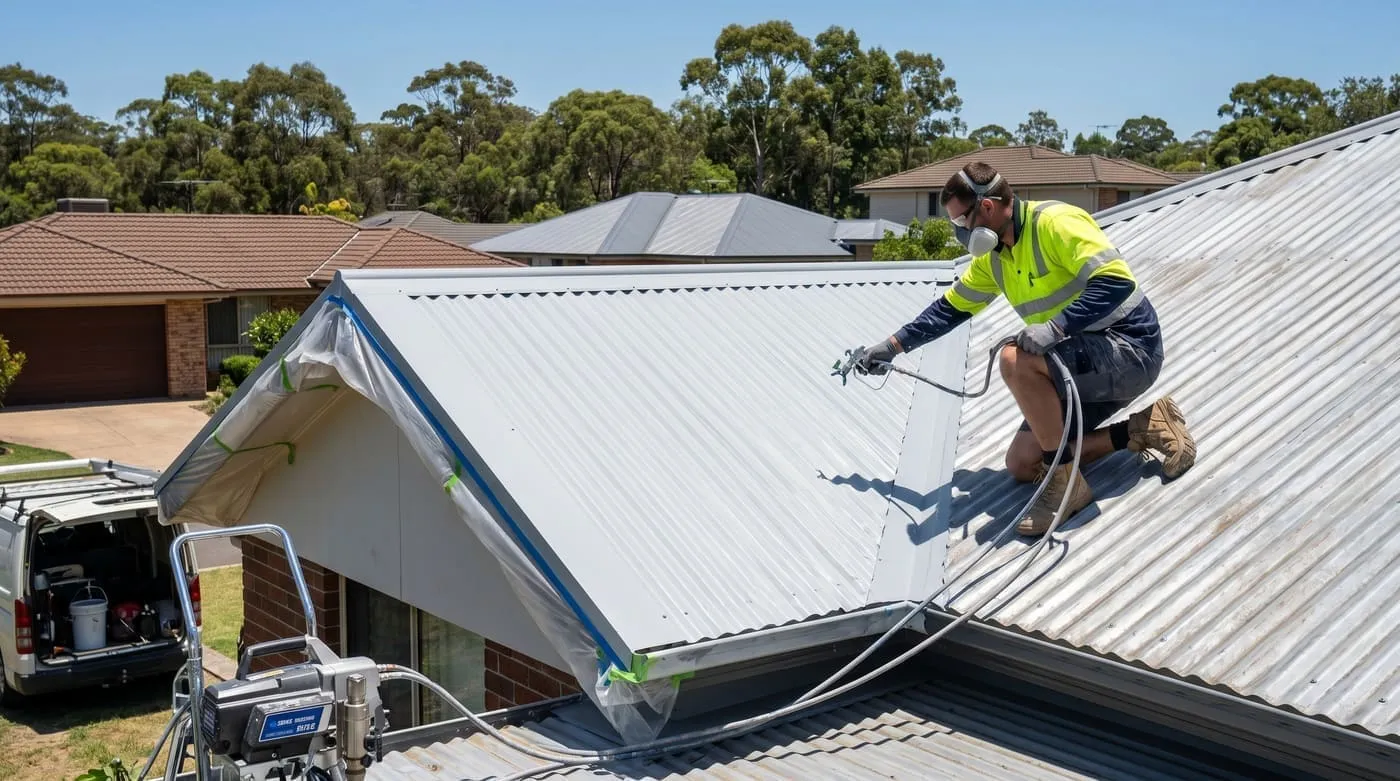
If you’re choosing colour for a brand-new Colorbond roof, you’re picking from the factory range and the colour is baked in. If instead you’re recoating an older metal or tile roof, you’ve got far more freedom — a roof painting or roof restoration job can go almost any colour, and you can add a heat-reflective membrane at the same time. That’s a cost-effective way to drop your roof’s heat load without a full re-roof. If you’re weighing that up, our guide on whether roof restorations are worth it walks through when a recoat makes sense versus replacement.
The most popular colours on Downs roofs right now
If you drive around the newer estates and re-roofed homes across Toowoomba and Highfields, a few colours come up again and again, and there’s good reasoning behind each.
Surfmist is the go-to for people chasing maximum coolness — it’s near the top of the reflectance range and gives a clean, light look that suits contemporary builds and renders well against most wall colours.
Shale Grey and Dune are the soft, light neutrals that hide dust and grime better than a stark white while still reflecting most of the summer heat. They’re forgiving against brick, weatherboard and render alike, which is why they’re so common.
Windspray and Basalt-adjacent mid-greys are for people who want a more grounded, modern look and are willing to trade a little heat performance for it. With good insulation and ventilation backing them up, they keep most homes comfortable.
Monument and the darker charcoals remain hugely popular for the bold, architectural look on modern homes — just go in knowing they run the hottest and lean harder on your insulation and ventilation to stay comfortable.
There’s no single right answer here. The reason these colours dominate is that they each solve the heat-versus-looks trade-off in a slightly different way, and the best one depends on which side of that trade-off matters more to you.
A quick word on gutters, fascia and walls
Roof colour rarely lives alone. The smartest-looking homes pick a roof colour and then tie the guttering, fascia and downpipes into a coherent scheme — often matching gutters to the roof for a clean, continuous line, or contrasting them deliberately for definition. If you’re re-roofing, it’s the natural moment to sort the gutters too, because they’re easiest to replace while the roof’s being worked on. Thinking about the whole package, rather than the roof in isolation, is what separates a sharp result from a mismatched one.
Choosing for your home
The “best” colour balances heat performance with how it looks on your house and street. We bring the full colour range to you and talk through the trade-offs so you get a roof that’s cool in both senses.
A few common questions
Will a light roof show dirt more? A little, especially right after a dust storm or a long dry spell when red dust settles on everything. But Colorbond’s finish sheds most of it with the next decent rain, and an occasional roof clean sorts the rest. In practice this puts very few people off a light roof.
Is the heat difference really enough to notice? On a hot Downs afternoon, yes. People who switch a dark roof for a light one during a re-roof or restoration regularly tell us the upstairs rooms and the western side of the house feel noticeably more bearable. It’s not magic — it won’t replace insulation or air conditioning — but it takes load off both.
Does roof colour affect my insurance or warranty? No. Colour is a finish choice, not a structural one. What matters for warranty is that the roof is installed correctly and the coating is genuine Colorbond or a quality membrane, not the shade you pick.
Should I just go white then? Not necessarily. Stark white roofs can cause glare for neighbours and don’t suit every home. Light tones like Surfmist and Dune get you most of the reflectance benefit without looking like a brand-new shed. The sweet spot for most Downs homes is “light to mid”, not “as white as possible”.
Whatever you land on, we’d rather you choose with eyes open than chase a trend you regret in three summers. Get a free quote and we’ll bring the samples and hold them against your house so you can see the real thing in real light. Building or re-roofing somewhere specific? See our Toowoomba roofing and wider Darling Downs service pages.