Queensland throws everything at a roof — searing UV, brutal summer heat, sudden hailstorms and high winds. On the Darling Downs you can add big day-to-night temperature swings and dust to the list. So what’s the best roof for these conditions? Let’s work through it properly, because the answer is about more than just picking a material off a brochure.
Quick answer: For the Queensland climate, a Colorbond steel roof in a light, heat-reflective colour is the best all-round choice. It withstands hail and high winds better than tile, won’t crack with big temperature swings, sheds heavy storm rain fast, and reflects summer heat when specified in lighter Thermatech colours. Pair it with quality insulation, sarking and roof-space ventilation, and it handles UV, heat, hail and storms better than any other common roofing option.
What our climate actually demands
Before naming a winner, it’s worth being clear about what a roof on the Downs has to survive, because each pressure points toward a particular kind of roof:
- Intense UV that breaks down weak coatings and perishes cheap flashings over time.
- Summer heat that loads up your roof cavity and pushes the air-conditioning hard.
- Hail that can crack and shatter brittle materials in a single storm.
- High winds that find and lift anything not fixed down properly.
- Torrential downpours that dump a huge volume of water in a short window and overwhelm undersized gutters.
- Big temperature swings between a cold inland night and a scorching afternoon, which make materials expand and contract.
A roof that’s “best for Queensland” is simply one that takes all six of those in its stride. Keep that checklist in mind and the choice gets a lot clearer — and you’ll spot quickly when a quote or a product is strong on one front but weak on another.
The short answer: well-specified metal
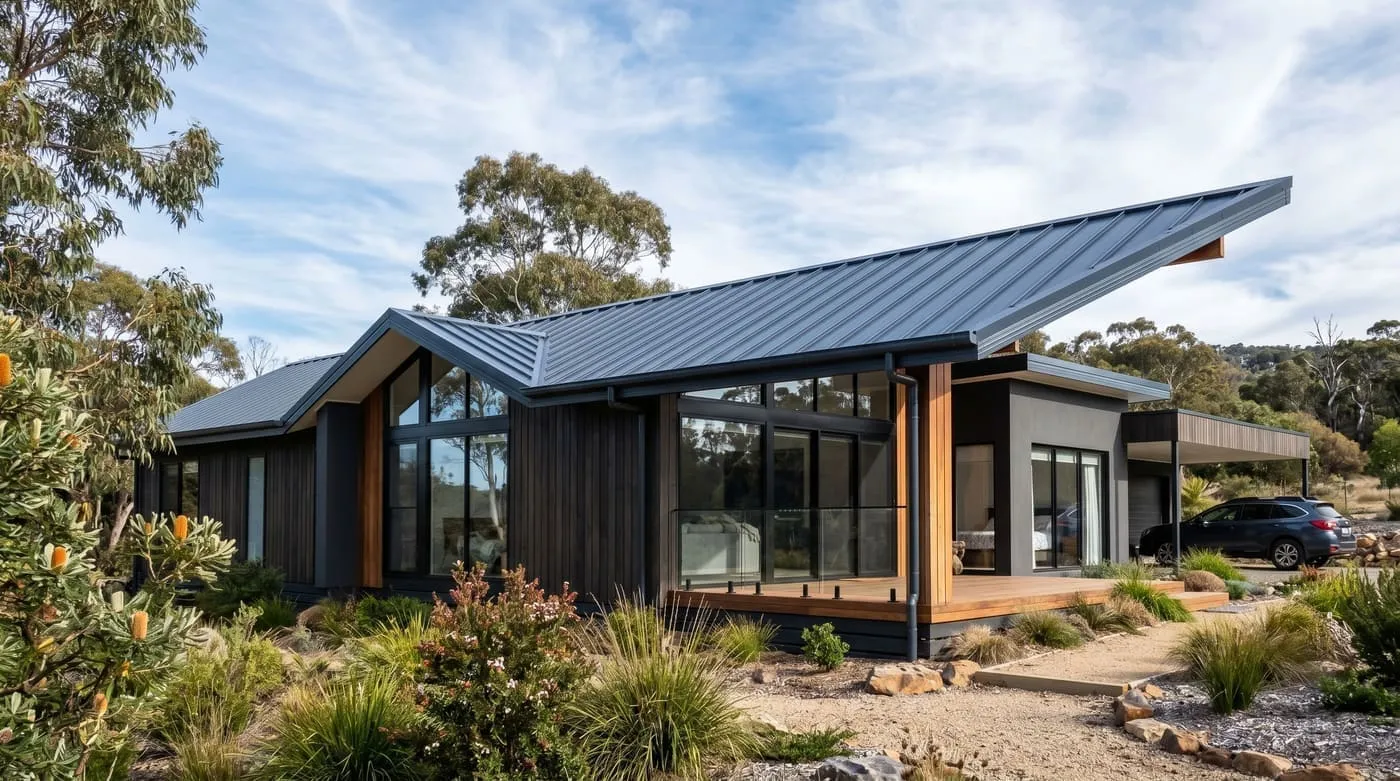
For most Queensland homes, a quality metal roof — Colorbond steel — is the standout choice, and here’s why it suits our climate so well:
- Handles hail and storms — steel flexes and resists impacts that crack tiles, and stays put in high wind when fixed properly
- Heat-smart — lighter Thermatech colours reflect more of the sun’s heat, easing the load on your air-conditioning
- Sheds water fast — vital when a Queensland downpour dumps a month’s rain in an hour
- Low maintenance — no moss, no re-pointing, no cracked tiles
- Light and durable — gentle on the structure and built to last decades inland
- Fire-resistant — non-combustible steel is reassuring on rural blocks and at the edges of town where bushfire is a consideration
It’s not just the material
The best roof isn’t only about what’s on top — it’s the whole system:
- Insulation — quality insulation keeps summer heat out and winter warmth in
- Ventilation — whirlybirds and vents flush hot, moist air out of the roof space
- Colour — lighter colours reflect more heat (more on that in our roof colour guide)
- Gutters — sized and maintained to handle heavy downpours, ideally with gutter guard
Get those right alongside the roofing material and you’ve got a roof that’s comfortable, efficient and tough. Skip them and even the best sheet on the market will underperform — the material sets the ceiling, but the system decides how close you get to it.
The trap of speccing for the brochure, not the location
A common and costly mistake is choosing a roof on looks or headline price without speccing it for where it actually sits. The same Colorbond sheet can be installed two ways: one with the correct fixing pattern for expansion, quality flashings that won’t perish under our UV, gutters sized for a real Downs storm and proper sarking — and one that’s been cut to a price on every one of those. They look identical the day the scaffold comes down. Five years later, one is shrugging off storm season and the other is leaking at a valley and streaking with rust at the fixings. “Best roof for the climate” isn’t only about the material on top; it’s about every detail being chosen for our weather rather than for the cheapest quote.
Why metal ticks every box
Run Colorbond steel against that six-point checklist and it’s easy to see why it’s the default for so many Queensland homes. The baked-on factory finish is engineered specifically for our UV. Lighter colours reflect a meaningful chunk of summer heat before it ever reaches your ceilings. Steel flexes under hail impact instead of shattering, and fixed correctly it holds firm in high wind. Its smooth, fast-draining profile clears a downpour quickly, and a roof installed with the right fixing pattern absorbs the daily expansion and contraction without working loose. No single material is perfect, but metal is the one that doesn’t have an obvious weak spot against what our weather does.
What about tile?
Tile still works in Queensland and has decent thermal properties, but it’s more vulnerable to hail, needs more maintenance, and is heavier. For a hail- and storm-prone region, metal’s resilience usually wins. That said, tile isn’t a bad roof — plenty of sound tile roofs across the Downs have years left in them, and if yours is in good shape, keeping and maintaining it can be the smarter spend than ripping it off. The case for metal is strongest when you’re building new, or when an old tile roof is genuinely worn out and you’re choosing what goes back on. See our full metal vs tile comparison for the detail.
Insulation and ventilation do the heavy lifting on heat
People focus on the roofing material when they think about a hot house, but in our summers the insulation and ventilation matter just as much. Quality ceiling insulation slows the heat that does get through from radiating down into your living spaces — it’s the single most cost-effective comfort upgrade on most homes. Ventilation is the other half: a roof cavity with no airflow becomes an oven by mid-afternoon, and that trapped heat soaks into the ceilings for hours after sunset. Whirlybirds or ridge vents flush that hot, moist air out and let cooler air draw in, dropping cavity temperatures noticeably. Get a sensible colour, good insulation and proper ventilation working together and even a darker roof can keep a house comfortable. Treat them as one system and the whole thing performs; treat them in isolation and you leave comfort on the table.
New build vs re-roof: the decision differs
If you’re building, you’ve got a clean slate — spec metal with good insulation, sensible colour and proper ventilation from the start and you’ll have a roof that’s set for our climate for decades. If you’re re-roofing an existing home, there’s an extra question first: does the roof actually need replacing, or would a restoration get you another decade-plus for far less? Coating over a failing roof is a waste, but replacing a sound-but-tired one is equally unnecessary. An honest inspection of the structure, not just the surface, answers it. We walk through how to make that call in our guide on restoration versus replacement.
Don’t forget the gutters
In a region defined by sudden, heavy downpours, gutters are part of the climate-proofing, not an afterthought. Undersized or blocked gutters can’t move water fast enough, so it backs up under the roof edge and overflows down your walls and against your foundations — a slow source of rot and damp that has nothing to do with the roof material itself. Sizing the gutters for a Downs downpour, keeping them clear, and adding gutter guard where trees are a problem rounds out a roof that genuinely handles our weather.
Common questions about roofing for our climate
Is a metal roof noisy in the rain? Far less than people expect on a modern roof with sarking and insulation underneath. The foil and batts dampen the sound considerably — most homeowners barely notice it, and plenty find the soft sound of rain pleasant.
Does a light roof really make a difference to my power bill? Yes, though it’s one factor among several. A lighter colour reflects more heat before it loads the cavity, which eases the cooling load through summer. Paired with good insulation and ventilation, the combined effect on comfort and running costs is genuinely worth having.
We get bad hail here — is any roof truly hail-proof? No roof is fully hail-proof against very large stones, but metal is the most resilient common choice: it dents rather than shatters, and dents are usually cosmetic rather than a leak. Tile, by contrast, can crack right through and let water in immediately.
I like the look of a dark roof — is that a mistake in Queensland? Not necessarily. A dark roof runs hotter, but with strong insulation and good ventilation you can have the look you want and still keep the house comfortable. The colour just does less of the work, so the system underneath has to do more.
Built for the Downs
We build roofs specifically for Darling Downs conditions, day in and day out, across Toowoomba and the surrounding towns. If you’re planning a new roof or a re-roof, get a free quote and we’ll spec the right system for your home and our climate — material, colour, insulation, ventilation and gutters as one package rather than parts bought in isolation.