People often ask us for “a roof restoration” as if it’s one fixed job. It isn’t. Restoring a tile roof and restoring a metal roof share the same goal — taking a sound but tired roof and getting another decade or more out of it — but the actual work is quite different. The steps, where the labour goes, and what can go wrong all change depending on what’s over your head. If you know which type you’ve got, this is what to expect.
Quick answer: A tile roof restoration and a metal roof restoration share the same goal but differ in the work. Tile restoration centres on the ridge caps — re-bedding and re-pointing the mortar — plus replacing cracked or slipped tiles, then cleaning and recoating; most of the labour is in the ridge work. Metal restoration focuses on rust treatment, refixing or replacing screws and damaged sheets, priming bare spots, then recoating; there’s no re-pointing. Both cost roughly $20–$40 per m² ($3,000–$8,000), but tile usually carries more hands-on prep labour.
| Factor | Tile restoration | Metal restoration |
|---|---|---|
| Main prep work | Re-bed and re-point ridge caps; replace cracked/slipped tiles | Rust treatment; refix/replace screws and damaged sheets |
| Where the labour goes | Ridge work across whole roof | Fixings, rust spots and sheet repairs |
| Cleaning | High-pressure clean off moss, lichen, old coating | Clean and prime bare metal |
| Coating | Primer/sealer + membrane coats | Primer + protective coats |
| Typical cost | ~$20–$40/m² · $3,000–$8,000 | ~$20–$40/m² · $3,000–$8,000 |
What a restoration is, on either roof
Whatever the material, a roof restoration follows the same broad shape: inspect, repair, clean, prepare, and coat. The roof has to be structurally sound to start with — a restoration refreshes and protects a good roof, it doesn’t rescue a worn-out one. If the bones are gone, you’re looking at a replacement instead, and an honest roofer will tell you which side of that line your roof sits on rather than coating over problems that will keep coming back.
The difference between tile and metal is in the detail of each of those steps. That detail is what drives the time, the cost and the result, so it’s worth understanding before you read a quote.
Restoring a tile roof
A tile restoration lives and dies by the ridge capping. The mortar bedding the caps cracks and crumbles over the years as the roof heats and cools, and once that pointing goes, water runs straight in. So the heart of a tile restoration is re-bedding the ridge caps — relaying the mortar base — and then re-pointing them with a flexible compound that copes with the constant expansion and contraction our climate puts roofs through. That work runs along every ridge and hip on the roof, which is why it’s the single biggest chunk of labour in a tile job.
Alongside that, a tile roof of any age usually has a number of cracked, chipped or slipped tiles to replace. These come from foot traffic, falling branches and hail, and every one of them is a potential leak. They get swapped out before anything else happens. The whole roof is then high-pressure cleaned to strip off dirt, moss, lichen and any flaking old coating — nothing new sticks to a dirty or mossy roof, and tile roofs on the Downs grow plenty of moss and lichen on their shaded southern faces. Finally the roof is sealed and coated, typically a primer followed by two coats of a quality membrane.
The thing to understand about a tile restoration is that most of the value is in the ridge work and the tile replacements — the steps you can’t see in the after photo. The coating is the finish, not the whole job.
Restoring a metal roof
A metal restoration spends its labour differently, because metal roofs fail in different ways. There’s no mortar and no re-pointing. Instead, the enemies are rust and fixings. The job starts with treating any rust — wire-brushing or grinding back surface rust, then priming the bare metal so the corrosion stops rather than spreading under a fresh coat. Any sheets that are too far gone get replaced, and the screws and fixings are checked: over the years, with all that expansion and contraction up on the range, fixings work loose or back out, leaving small gaps for water and wind. They get refixed or replaced.
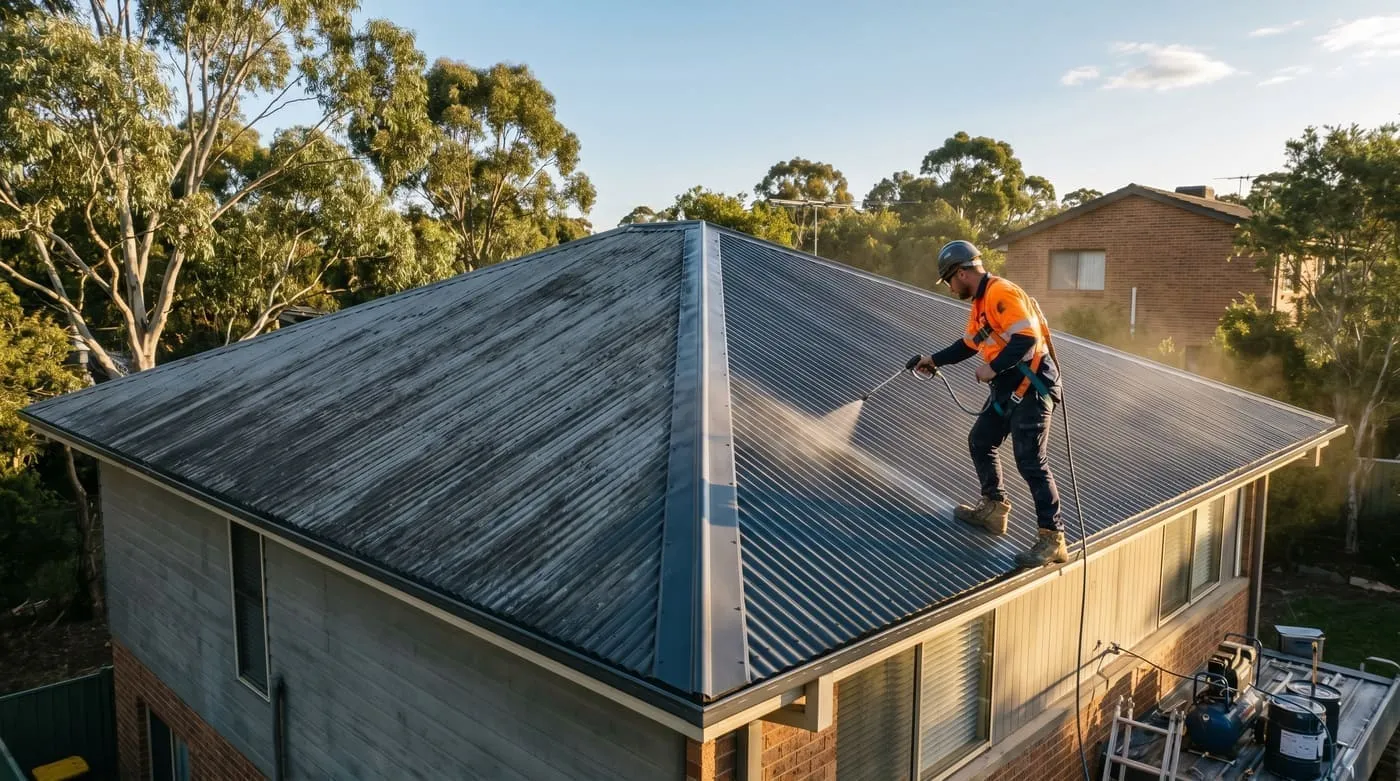
From there the process looks more familiar — a thorough high-pressure clean to remove chalky, oxidised old coating and grime, because a recoat won’t bond to a chalky surface, then a primer and two coats of a quality membrane. A metal roof in reasonable condition that mostly needs a clean, a few fixings and a recoat can come through tidily and quickly. The catch is rust: light surface rust is straightforward, but widespread rust that’s eating through sheets is a different story, and at some point heavy rust tips the maths toward re-roofing rather than restoring. We’ll always tell you honestly where your metal roof sits.
Where the cost goes on each
Because the work differs, the cost lands differently too. On a tile roof, the labour concentrates in the ridge capping and tile replacements — hands-on work across the whole roof, and time is most of the cost. That’s why a large or steep tile roof can sit toward the upper end of the range. On a metal roof, the variable is rust: a sound metal roof recoats economically, while a rusty one climbs fast as more sheets need treatment or replacement.
For a feel for the numbers, our roof restoration cost guide for Toowoomba breaks down indicative ranges and what moves the price. The short version: both roof types restore for a fraction of what a full replacement costs, but the way the quote is built up is genuinely different, and that’s worth knowing when you compare quotes. For the wider picture on reading any roofing quote fairly, see our guide on what affects a roofing quote.
How long each lasts after restoration
A well-done restoration on either roof typically buys you another 10 to 15 years before the next major attention, provided the roof was sound to begin with and the coating used was a quality product rather than a cheap one. The maintenance pattern afterwards differs, though. A restored tile roof will still need its ridge capping watched — pointing is a wear item, and it’ll need attention again down the track. A restored metal roof asks less between now and the next recoat, mostly an occasional rinse and a check of the fixings.
This mirrors the ongoing difference between the two materials in general. If you’re weighing up tile versus metal as a material choice rather than a restoration, our metal vs tile roof comparison covers that side of the decision.
The clean step: closer than the rest
One stage that’s broadly similar on both roofs, but worth dwelling on, is the clean. Whatever the material, the roof has to be properly stripped of dirt, chalk, moss, lichen and flaking old coating before anything new goes on, because a fresh coat simply won’t bond to a dirty or contaminated surface. A cheap “restoration” that skips a proper clean is the single most common reason a coating peels within a year or two — the product never had a clean surface to grip.
On tile, the clean usually means dealing with moss and lichen on the shaded faces as well as general grime, which takes time and the right pressure to avoid cracking tiles. On metal, the job is mostly stripping the chalky, oxidised layer that a tired coating leaves behind. Either way it’s high-pressure work that needs judgement — too much pressure cracks tiles or drives water under laps, too little leaves a surface the coating can’t bond to. It’s a good example of why the material changes the detail even on a step that sounds identical in a quote.
Reading a restoration quote for each type
Because the work differs, the line items you should expect in a quote differ too, and knowing that helps you tell a real restoration from a wash-and-spray. On a tile roof, a proper quote should spell out tile replacement, ridge-cap re-bedding and re-pointing (they’re two separate jobs — bedding is the mortar base, pointing is the flexible compound over it), the clean, and the number of coats and the product used. If a tile quote doesn’t mention re-bedding or re-pointing, it’s not a full restoration.
On a metal roof, the quote should set out rust treatment, fixing replacement, any sheet replacement, the clean, and again the number of coats and the product. If a metal quote is silent on rust treatment and fixings, the same warning applies. In both cases, repairs should be included in the price rather than sprung on you later as “we found more once we got up there”. A clear, itemised quote is what lets you compare like with like — and it’s exactly what separates the professionals from the chancers.
Common questions about restoring tile vs metal
Can any tile or metal roof be restored? No. Restoration works on a roof that’s structurally sound but cosmetically and superficially tired. A tile roof with widespread cracking, failed sarking or sagging battens, or a metal roof with rust eating right through the sheets, is past restoring — that’s replacement territory, and coating over it just wastes money.
Is one type cheaper to restore than the other? It depends on condition more than material. A sound metal roof that just needs a clean and recoat is often the cheaper job. A tile roof always carries the ridge-capping labour, so it rarely comes in at the very bottom of the range, but a rust-ridden metal roof can easily cost more than a tidy tile one.
Does a tile restoration include replacing broken tiles? It should. Replacing cracked and slipped tiles is a core part of the job, not an optional extra — leaving them in defeats the purpose. Always check the quote spells out that repairs are included rather than charged later as “we found more cracked tiles”.
Will a restoration fix a leaking roof? Often, yes, if the leak is from the things a restoration addresses — failed pointing, a cracked tile, a loose fixing or a tired coating. But a leak from a structural fault or a badly designed valley needs proper leak repair first; a restoration isn’t a blanket fix for every leak.
Which restoration is right for your roof
You don’t get to pick — your roof picks for you. If you’ve got tiles, you’re getting the ridge-and-tile job; if you’ve got metal, you’re getting the rust-and-recoat job. What you do get to control is choosing a roofer who does the full process properly rather than a quick wash and a thin spray that looks fine for a year and then peels. The difference between a cheap “restoration” and a real one is all in the preparation and repair steps, on both materials.
Not sure whether your roof is worth restoring at all, or whether you’d be throwing good money after bad? That’s exactly the call we’ll make honestly for you. We work across Toowoomba and the wider Darling Downs, and we’ve talked plenty of people out of a restoration when a replacement was the smarter spend. Get a free, no-obligation inspection and quote and we’ll tell you straight which job your roof actually needs.