You get three quotes for the same roof and they land thousands of dollars apart. It’s enough to make anyone suspicious — is someone ripping you off, or is someone else cutting corners? Usually it’s neither in the way you’d think. Roofing quotes vary because roofs vary, and because not every quote is measuring the same job. The lowest number isn’t automatically the best deal, and the highest isn’t automatically a rip-off. The skill is knowing what drives the price and how to line quotes up so you’re comparing like with like. Here’s how to do exactly that.
Quick answer: Roofing quotes vary mainly because of roof size, pitch, access, condition and — above all — what each quote actually includes. To compare fairly, stop comparing totals and start comparing inclusions: get every quote itemised, line them up against the same scope, and find the gaps. As a rough reference, restorations run ~$20–$40/m² ($3,000–$8,000), metal re-roofs ~$90–$130/m² ($12,000–$25,000), and gutter replacement ~$30–$50 per linear metre. These are indicative estimates only — every roof is different, so get a free quote.
Indicative cost ranges to sense-check a quote
Before you compare quotes, it helps to know roughly where each type of job should land. Use these as a sanity check, not a quote — every roof is different.
| Job / scope | Indicative cost |
|---|---|
| Roof restoration | ~$20–$40/m² · $3,000–$8,000 total |
| Metal/Colorbond re-roof | ~$90–$130/m² · $12,000–$25,000 total |
| Tile-to-metal conversion | ~$15,000–$25,000+ |
| Gutter replacement | ~$30–$50/linear metre · $2,000–$6,000 total |
If a quote sits well outside these, it’s worth asking why — it may be doing less (or more) than you think.
What actually drives a roofing quote
Before you can compare quotes, it helps to understand where the money goes. A handful of factors do most of the work in setting the price, whether it’s a repair, a restoration or a full re-roof.
- Roof size. More square metres means more materials, more labour and more time. It’s the single biggest lever on most jobs.
- Pitch and complexity. A steep roof is slower and needs more safety setup. So does a cut-up roof with lots of valleys, hips, dormers and penetrations — each junction is extra detailing and extra places to get the waterproofing right.
- Access. A single-storey home on a flat block is straightforward. A two-storey, a steep site, or somewhere a truck and scaffold can’t easily get to all add labour and safety cost.
- Roof type and material. Tile and metal need different processes. The product you choose — profile, grade, Colorbond colour — moves the figure too.
- Condition and prep. A roof needing rust treatment, lots of tile replacements, extensive re-pointing or structural repairs costs more than one that just needs the main work. On a re-roof, what’s found once the old roof comes off can change things.
- What’s included. This is the big one for comparing quotes, and it deserves its own section below.
Why two quotes for “the same job” differ so much
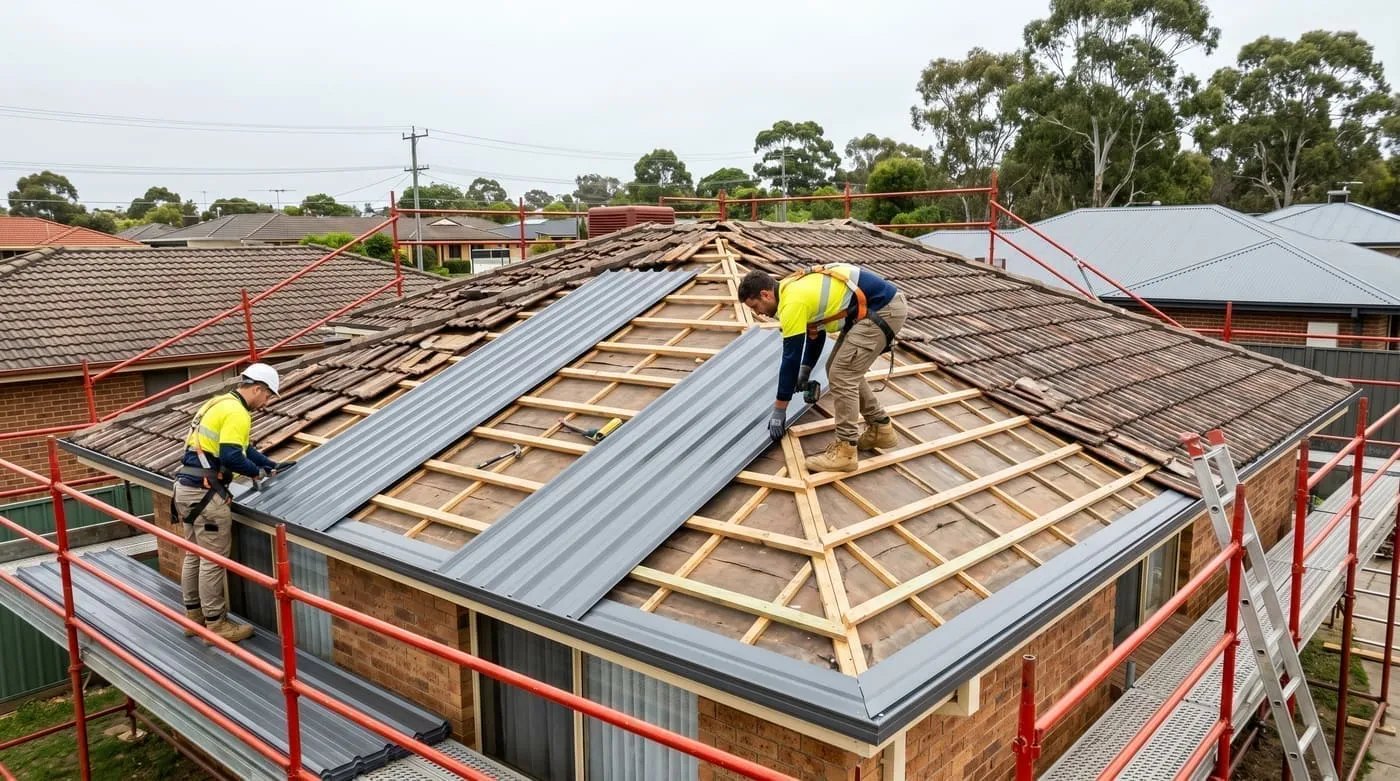
Here’s the trap. Two quotes can both say “roof restoration” or “re-roof” and describe genuinely different amounts of work. On a restoration, one quote might include repairs, re-bedding, re-pointing, a thorough clean and two coats of quality membrane. Another might be a quick pressure wash and a single thin coat sprayed over the existing problems. They’ll look wildly different on price — and the cheap one will look far worse in two years when it’s peeling and the unrepaired faults are leaking.
On a replacement, the difference often hides in the detailing: the quality of the flashings, valley irons, ridge and barge caps, the fixings, and whether the sarking and insulation are being renewed or just left as they are. A roof is only as watertight as its weakest flashing, so a quote that trims those to win on price is selling you a future leak. The headline numbers tell you almost nothing on their own. You have to look at what each one actually covers.
What a proper quote should itemise
A professional quote should be written, clear and itemised — not a number scribbled on the back of a card. When you can see the line items, comparing quotes becomes simple. Look for these spelled out:
- The scope of work — exactly what’s being done, in plain terms
- Materials — product, profile, colour, grade, and how many coats where relevant
- Repairs and prep — what’s included versus what would be an extra
- Removal and disposal of the old roof or debris
- Flashings, ridge caps, valleys and fixings — the detailing, not just the sheets
- Access and safety — scaffolding and site setup
- Cleanup and rubbish removal
- Warranty — workmanship and materials, in writing
- Payment terms — deposit and progress payments
If a quote is vague on these, it’s not that the work isn’t needed — it’s that it’ll likely turn up later as a variation, and your “cheap” quote climbs.
How to compare quotes fairly: a simple method
The way to compare fairly is to stop comparing totals and start comparing inclusions. Here’s a method that works:
- Get everything in writing and itemised. If a quote isn’t, ask for it to be. A reluctance to itemise is itself a useful signal.
- Line the quotes up side by side. Make a simple list of inclusions down the left and a column for each quote. Tick off what each one covers.
- Find the gaps. Where one quote includes something another doesn’t — repairs, sarking, an extra coat, gutter replacement, structural allowance — note it. That’s usually where a price difference comes from.
- Normalise the scope. Mentally (or out loud, by asking) bring every quote up to the same scope. Often the “cheap” quote isn’t cheap once you add back what it left out.
- Then weigh price against the rest — licensing, insurance, warranty, reputation and how thorough the inspection was. The best value is rarely the lowest number, but it’s also rarely the highest.
Done this way, the quotes start to make sense, and the one that looked suspiciously cheap usually reveals why.
Red flags that explain a suspiciously low quote
When one quote is dramatically lower than the others, there’s nearly always a reason. Common ones:
- It skips the repairs and prep and just does the headline work over the top of existing problems
- It uses cheaper materials or fewer coats than the others
- It quotes from the ground without a proper inspection, so the “missing” work shows up as variations later
- It leaves out disposal, scaffolding or cleanup that the other quotes included
- The roofer isn’t carrying the insurance or licensing that legitimate operators price in
None of these make a quote dishonest by itself — but they explain the gap, and they tell you the two numbers were never comparable.
What “expensive” can buy you (and what it shouldn’t)
Equally, a higher quote isn’t proof of quality. A fair higher price usually reflects better materials, more thorough prep and repairs, proper detailing, a real workmanship warranty, and the overheads of a properly licensed and insured local business. Those are worth paying for. What you shouldn’t pay for is padding, pressure or vagueness — a high number with no itemisation is as much a warning sign as a suspiciously low one. The goal isn’t cheapest or dearest; it’s the quote where the scope, quality and price all make sense together.
Beware the storm-chaser quote
After a big storm rolls through the Downs, out-of-town operators appear, quote cheap and fast, and are gone before the work could ever be tested. Their quotes can look great on paper precisely because they’re not factoring in standing behind the job. A local roofer is invested in their reputation, knows our climate, and is still here if you need them in a year. When you’re comparing quotes after storm damage especially, “local and contactable next season” is part of the value, not a nicety. We dig into the warning signs in our guide on questions to ask a roofer before you hire.
Make sure you’re comparing the right job, too
Sometimes the biggest variable isn’t the quotes — it’s whether the work itself is the right call. If one roofer quotes a full replacement and another quotes a restoration, you’re not comparing prices, you’re comparing diagnoses. Some roofers quote the bigger ticket because it’s the bigger ticket; an honest one tells you when the cheaper option is genuinely right for your roof. Before you weigh up quotes, make sure you’ve had an honest assessment of whether your roof needs a restoration or a replacement in the first place. Comparing two quotes for the wrong job is a fast way to overspend.
Questions to ask before you sign
A few direct questions cut through a lot of uncertainty:
- What exactly is and isn’t included in this price?
- What happens if you find extra work once you start — how is that priced and approved?
- What product and how many coats, and why that choice for my roof?
- What’s the workmanship warranty, in writing?
- Are you licensed and insured, and can I see proof?
- Did you get up on the roof to quote this, and can I see the photos?
A good roofer answers all of these happily — in fact, they’ll respect you for asking. Evasiveness on any of them is worth more than the dollar figure on the quote.
The bottom line
Roofing quotes vary for real reasons — size, pitch, access, condition and, above all, what each one actually includes. The way to protect yourself isn’t to grab the cheapest or assume the dearest is best; it’s to get everything itemised, line the quotes up against the same scope, and find the gaps. Do that and the right choice usually becomes obvious.
We quote clearly and itemised, get up on the roof before we put a number on it, and tell you straight what the work needs — including when the cheaper option is the right one. If you’d like a quote you can actually compare, for a home anywhere across Toowoomba and the Darling Downs, get a free, no-obligation quote and see the difference a clear one makes.