Planning a re-roof and wondering if you need to involve the council? It’s a sensible question. The good news is that most straightforward roof replacements don’t require a development approval — but there are important exceptions. Here’s the general picture.
Quick answer: In Queensland a building approval is generally required once roofing work replaces more than around 20% of the existing roof area. Minor, like-for-like repairs and replacements under that threshold — same shape, pitch and height, no structural change — are typically exempt. A tile-to-metal conversion may also need engineering or structural (tie-down) certification. This is general guidance only — always confirm with your local council or building certifier, as rules and your specific situation can vary.
General information only — always confirm your specific situation with your local council (in our area, Toowoomba Regional Council) or a building certifier.
Like-for-like replacement: usually no approval
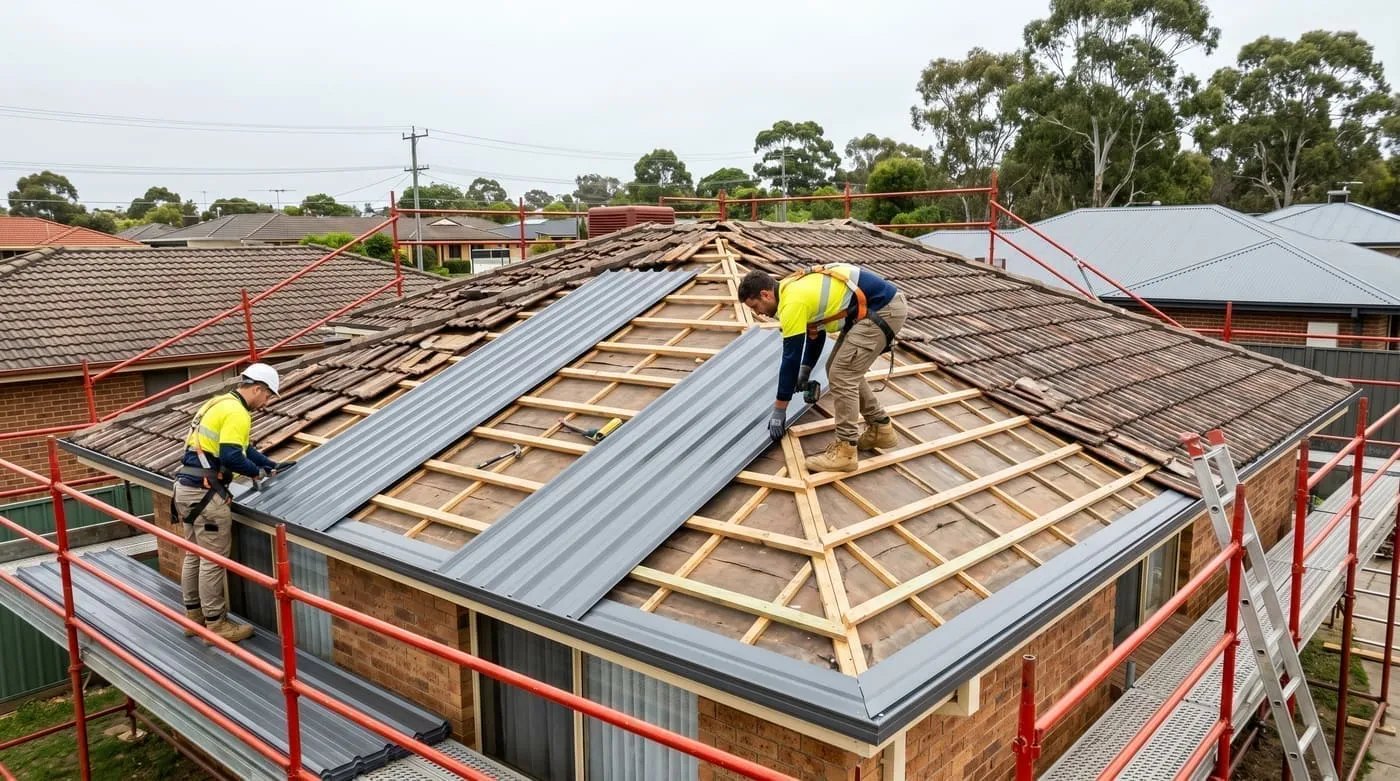
A straightforward roof replacement — swapping an old roof for a new one of similar form and height, with no structural change — is generally treated as maintenance/repair and typically doesn’t need development approval. Re-roofing your existing house with new Colorbond, for example, usually falls here.
As a general rule of thumb, a building approval is more likely to be triggered once the work replaces more than around 20% of the existing roof area. Minor, like-for-like repairs and partial replacements under that threshold are commonly exempt, while a full re-roof of the same form and height is usually still treated as repair and maintenance. Where the work changes the structure — or where you’re converting tile to metal — separate engineering or structural (tie-down) certification can also come into play. Because these thresholds and how they’re applied vary, confirm your specific situation with your local council or a building certifier before you start.
When approval may be needed
You’re more likely to need approval or extra steps when the work goes beyond like-for-like:
- Changing the roof structure or pitch, or significantly altering the roofline
- Heritage-listed properties or homes in a heritage or character overlay
- Raising the roof height or major structural changes
- Building a new structure (a new patio, carport or extension roof) rather than replacing an existing one
The bigger requirement: a licensed contractor
Whether or not council approval applies, roofing work over a certain value in Queensland must be carried out by a QBCC-licensed contractor, and certain work requires the appropriate licence and insurance. This protects you — it means the work is done to standard and you’re covered. Always check your roofer is properly licensed (we cover this in questions to ask a roofer).
Why the like-for-like rule exists
It helps to understand the thinking behind it. Councils and the building rules are mainly concerned with changes that affect safety, the look of an area, drainage, or the structure of a building. Swapping a worn-out roof for a new one of the same shape, height and pitch doesn’t change any of those things — the building stays the same size and form, it’s just got a fresh, sound roof on top. That’s why a straight re-roof is generally treated as ordinary repair and maintenance.
The moment your project starts to change the building — a steeper pitch, a higher ridgeline, a new dormer, a different roof shape, or a brand-new roofed structure — you’re potentially in territory that affects neighbours’ outlook, stormwater, or the building’s structural loads. That’s when approvals and certification come into the picture. So a useful rule of thumb: if the new roof looks and sits essentially like the old one, you’re probably fine; if it noticeably changes the building, check before you start.
What a like-for-like re-roof still has to get right
“No development approval” is not the same as “no rules.” Even a straightforward replacement still has to meet the Building Code and the relevant Australian Standards — the right fixings for our wind region, correct flashing and weatherproofing, proper falls on the roof, and safe disposal of the old material. These are about the roof being built correctly and safely, not about council sign-off, and they’re exactly the things a properly licensed roofer handles as a matter of course.
This is also where solar, skylights and roof penetrations come in. Adding solar panels or a new skylight during a re-roof can carry its own requirements, and electrical work always needs the appropriate licensed trade. If you’re planning to add anything beyond the roof itself, mention it early so it can be planned and done correctly the first time.
A simple way to work out where you stand
If you’re trying to gauge your own situation before picking up the phone, run through these questions:
- Is the new roof the same shape, pitch and height as the old one? If yes, you’re most likely in like-for-like territory.
- Is the property heritage-listed, or in a heritage or character overlay? Around Toowoomba there are pockets of lovely older homes that fall under these, and they bring extra steps.
- Are you changing the structure — raising the roof, altering the frame, or adding a new roofed area like a patio or carport? That usually pushes you past simple replacement.
- Does the old roof contain asbestos? That triggers separate removal and disposal rules regardless of approvals.
- Is the work being done by a properly licensed contractor? This one isn’t optional for work of any real size.
If you answered “same as before” to the structural questions and you’re using a licensed roofer, a typical re-roof is usually the smooth, no-approval path. If anything else is a “yes,” it’s worth a quick check with the council before committing.
Heritage and character homes
Toowoomba and the surrounding towns have a genuine stock of older, character housing — timber-and-tin cottages, federation homes and the like — and some sit within heritage or character protections. If yours does, even a like-for-like re-roof can come with conditions about materials, profiles or colours so the result stays in keeping with the home and the streetscape. It doesn’t mean you can’t re-roof; it means there may be an extra approval or a few constraints on what you use. The council can tell you quickly whether your address is affected, and we’re happy to work within those requirements when it is.
Records and your roofer’s responsibilities
For a like-for-like replacement, you generally won’t be lodging paperwork yourself. Where approvals or certification do apply, your licensed contractor will typically be the one navigating that with you, and any work covered by the relevant home warranty insurance scheme is handled through your contractor as well. The practical takeaway: keep your quote, contract and any certificates or compliance paperwork in one place. They’re worth having if you ever sell the home, make an insurance claim, or simply want proof the work was done properly.
Asbestos adds rules
If your old roof contains asbestos (common on older homes and sheds), its removal and disposal are tightly regulated and must be done safely and correctly. We manage compliant asbestos roof removal as part of a replacement.
Common questions about council approval
Do I need approval just to put new Colorbond on my existing house? In most straightforward cases, no. Re-roofing your existing home with new steel of the same form and height is generally treated as repair and maintenance and typically doesn’t need a development approval. The work still has to be done correctly and to standard by a licensed roofer, but you’re usually not lodging an application for a simple like-for-like swap. Always confirm with your council and roofer for your specific home, though.
What if I want to change the roof colour? Colour alone isn’t normally a planning issue on an ordinary home — you can generally pick whatever Colorbond colour you like. The exception is heritage or character-protected properties, where the colour, profile and materials may be subject to conditions to keep the home in keeping with its surroundings. If you’re in one of Toowoomba’s character areas, check before you settle on a colour.
Does adding insulation or sarking during the re-roof change anything? Upgrading sarking and insulation while the roof is open is normal good practice and doesn’t, by itself, turn a maintenance job into something that needs approval. It’s improving the existing roof, not changing the building’s form. It’s one of the smartest things to do during a replacement because access is already set up.
What about a new patio or carport roof? That’s a different category. Building a brand-new roofed structure — rather than replacing an existing roof — generally does involve approvals and certification, because you’re adding to the building. If your project includes a new patio, carport or extension, treat that part separately and check the requirements before you start.
Who actually deals with the council if approval is needed? For work that requires it, your licensed contractor or a building certifier will typically guide the process with you. You don’t have to become an expert in the rules — you do need to choose a roofer who knows when something needs more than a like-for-like swap and will tell you honestly. That early conversation is what keeps the whole thing simple.
How do I check if my property has a heritage or character overlay? Your local council can tell you quickly from your address — it’s worth a short call before you commit to anything if you own an older home. The council holds the planning maps and overlays, so they’re the definitive source rather than guessing from the age of the house.
What this means for your project
Pulling it together: for the typical Toowoomba and Darling Downs homeowner replacing a worn-out roof with a new one of the same shape and height, a development approval usually isn’t part of the picture — but a properly licensed contractor, correct building standards, and safe handling of any asbestos absolutely are. The cases that need more attention are heritage and character homes, anything that changes the roof’s structure, pitch or height, and any brand-new roofed structure. When in doubt, a quick check with the council and an honest roofer sorts it out before any work begins, so there are no surprises partway through.
The easy path
The simplest approach: talk to a licensed local roofer early. We deal with Toowoomba-area roofing regularly, know when something needs more than a like-for-like swap, and can point you in the right direction. Get in touch and we’ll help you plan it properly.