If your house turns into an oven on a hot Toowoomba afternoon and stays that way long after the sun’s gone down, the problem might not be your air conditioning or your insulation. It’s often the roof space above the ceiling, baking all day with nowhere for the heat to escape. Roof ventilation is one of the least understood and most overlooked parts of keeping a house comfortable in our summers — so here’s a plain-English guide to what it does and whether your home needs it.
Quick answer: Roof ventilation lets the hot, trapped air in your roof space escape and draws cooler air in, stopping the cavity above your ceiling from baking all day and radiating heat into the home. In a Toowoomba summer it makes upstairs rooms more comfortable, eases the load on air conditioning, and helps clear moisture that can cause condensation and mould. Whirlybirds, ridge vents and powered or solar vents all do the job — paired with good insulation, ventilation is one of the cheapest ways to cool a hot house.
What roof ventilation actually does
The space between your ceiling and your roof — the roof cavity — heats up dramatically on a sunny day. A dark metal or tile roof in full Darling Downs summer sun can push the air in that cavity well above the outdoor temperature. That superheated air sits there, radiating down through your ceiling into the rooms below, long after the afternoon has cooled off. It’s why your bedrooms can still feel stuffy at 10pm in January.
Roof ventilation gives that hot air a way out. The principle is simple: hot air rises, so you let it escape high up near the ridge while drawing cooler air in lower down at the eaves. Done properly, it creates a continuous flow that flushes the worst of the heat out of the roof space instead of letting it bank up and soak into the house. It won’t make your home as cold as a fridge, but it takes the edge off the heat that your insulation alone can’t deal with.
Why it matters more on the Downs than people think
Toowoomba and the surrounding Downs sit up on the range, and our climate has a particular character: hot, often dry summer days followed by big temperature drops at night. That swing is actually an opportunity. A well-ventilated roof space sheds its heat quickly once the outside air cools in the evening, so the house follows the outdoor temperature down rather than holding onto the day’s heat for hours. A poorly ventilated roof, by contrast, traps the heat and keeps radiating it well into the night, which is exactly when you’re trying to sleep.
There’s a winter and wet-season benefit too, which people forget. A ventilated roof space stays drier, because moisture — from the household below, from the occasional leak, from humid air — can move out instead of sitting in the cavity. Trapped moisture is what feeds timber rot, mould and the slow degradation of insulation. So ventilation isn’t only a summer comfort thing; it protects the roof structure year-round.
The signs your roof isn’t venting well
You don’t need to climb into the roof to suspect a ventilation problem. The tell-tale signs show up in how the house behaves and what you find when you do look:
- Upstairs or top-floor rooms that stay hot late into the evening, well after the outside has cooled.
- An air conditioner that runs and runs without ever really winning against the heat in the worst rooms.
- A roof cavity that feels like an oven when you open the manhole on a summer afternoon.
- Musty smells, damp patches or mould in the roof space or on upper ceilings, pointing to trapped moisture.
- Condensation on the underside of metal roofing in the cooler months, dripping onto insulation.
Any of these is worth a closer look. None of them fixes itself, and a stuffy, damp roof space only gets worse over time.
The ways a roof can be ventilated
There’s no single “best” system — the right approach depends on your roof type, its pitch, and how the house is built. The common options work together rather than competing:
Ridge and eave ventilation is the classic passive setup. Vents along the ridge let hot air out at the top, while gaps or vents at the eaves let cooler air in at the bottom. No power, no moving parts, just physics doing the work. It’s quiet, reliable and cheap to run because it runs on nothing.
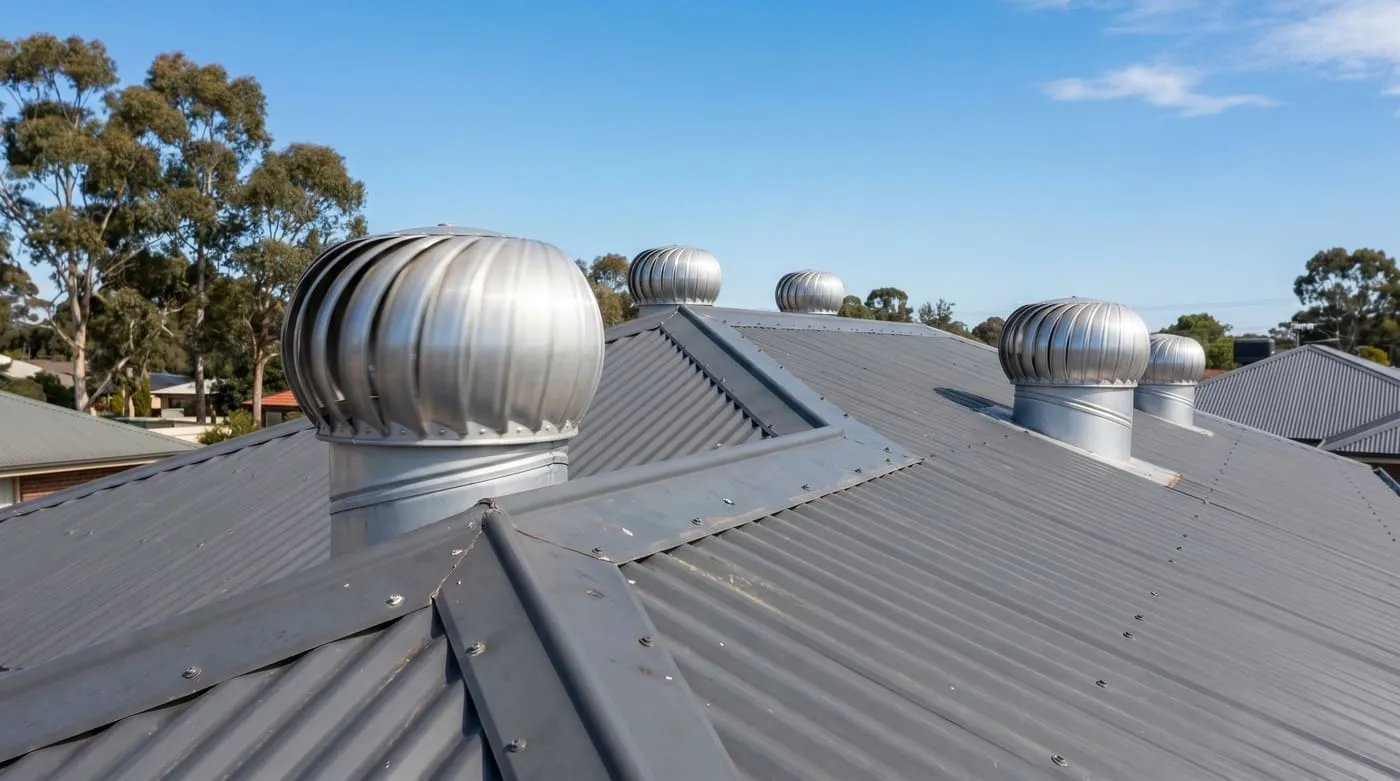
Whirlybirds (those spinning turbine vents you see on roofs) are a familiar passive option. The wind spins them and they draw air out of the cavity. They’re inexpensive and work reasonably well, though a single one on a big roof won’t shift much air on a still day.
Powered vents use a small fan, sometimes solar-powered, to actively pull hot air out. They move far more air than a passive vent and are useful on large or stubborn roof spaces, or where passive ventilation alone isn’t keeping up. The solar versions cost nothing to run and do their hardest work exactly when the sun is hottest.
The key with all of them is balance: you need air coming in as well as going out. Plenty of roofs have exhaust vents up high but no intake down low, so they can’t actually flow. A good setup gets both ends right.
Ventilation, insulation and colour work together
Ventilation isn’t a magic bullet on its own — it’s one of three levers that together decide how hot your house gets, and they work best in combination. Insulation slows heat moving from the roof cavity into your rooms. Ventilation flushes the heat out of the cavity before it gets that far. And the colour and type of your roof decides how much heat lands in the first place — a light-coloured roof reflects far more summer sun than a dark one, which is why roof colour does real work in our climate, as we cover in our guide to the best roof colour for a hot QLD climate.
Skimp on any one of the three and the others have to work harder. A dark, poorly ventilated roof with thin insulation will cook a house no matter how good the air conditioner is. Get all three pulling in the same direction and you’ve got a home that stays liveable through a Downs summer without the power bill of running the air con flat out. If you’re already planning a roof restoration or re-roof, that’s the ideal time to sort ventilation while access is set up.
Tile versus metal roofs and ventilation
The roof material over your head shapes how the cavity behaves, and that’s worth knowing when you’re working out what to do. Tile roofs have a bit of natural breathing built in — the overlapping tiles aren’t perfectly sealed, so a small amount of air moves through the gaps, and tile’s thermal mass means the cavity heats and cools more slowly. That doesn’t make ventilation unnecessary, but it does mean the heat builds and releases more gradually, and ridge venting works well to flush the worst of it.
Metal roofs are a different story. A metal roof seals up tightly and heats fast and hard in direct sun, so the cavity under it can get extremely hot extremely quickly on a Downs summer afternoon. Metal also gives up its heat fast once the sun’s off it, which is good — but only if there’s somewhere for that heat to go. A sealed, unventilated metal roof cavity bakes and then radiates that heat down for hours. Metal roofs are also the ones most prone to underside condensation in the cooler months, where warm moist air hits cold steel and drips onto the insulation. For both reasons, a metal roof often benefits even more from good intake-and-exhaust ventilation than a tile one does.
When to sort ventilation out
The cheapest time to address ventilation is when you’re already having other roof work done. If you’re planning a roof restoration, a recoat or a re-roof, the roof is open and access is set up, so adding or improving vents costs far less than a separate job later. It’s also the natural moment to get the whole picture right at once — insulation, ventilation and a sensible roof colour all sorted together rather than piecemeal.
That said, ventilation absolutely can be retrofitted on its own at any time, and on most roofs it’s a quick job. If your house is unbearable upstairs every summer and a re-roof isn’t on the cards for years, there’s no reason to wait — adding ridge vents or a solar-powered vent now will pay off every hot afternoon between now and then. The main thing is to get the balance right: intake low at the eaves, exhaust high near the ridge, so the cavity actually flows rather than just having holes in it.
Common questions about roof ventilation
Will roof ventilation really make my house cooler? It won’t air-condition your home, but it removes the worst of the trapped heat from the roof space so less of it radiates down into your rooms — most noticeably in the evening, when a ventilated roof sheds its heat and an unventilated one keeps radiating. Paired with good insulation, the difference in upstairs comfort is genuine.
Are whirlybirds enough on their own? On a small roof, maybe. On a larger one, a single whirlybird shifts surprisingly little air, especially on a still day, and it needs adequate intake at the eaves to work at all. For a bigger or hotter roof space, ridge venting or a powered vent usually does far more.
Does ventilation help in winter too? Yes, in a different way. It keeps the roof cavity drier by letting moisture and condensation escape, which protects timber and insulation from rot and mould. A ventilated roof isn’t a cold roof — the insulation still keeps your warmth in — but it is a healthier, drier one.
Can ventilation be added to an existing roof? Almost always, yes. Ridge vents, whirlybirds and powered vents can all be retrofitted to most tile and metal roofs without re-roofing. It’s a relatively quick job compared with most roofing work, and it’s often the cheapest comfort improvement you can make.
Is it worth doing?
For a lot of Toowoomba and Darling Downs homes, improving roof ventilation is one of the best-value things you can do for summer comfort — cheaper than re-roofing, cheaper than running the air con harder, and it pays off every hot afternoon for years. It’s especially worth it if you’ve got hot upstairs rooms, a roof cavity that bakes, or any sign of trapped moisture.
The honest caveat is that ventilation works best as part of the whole picture. If your insulation is thin or your roof is dark and tired, ventilation alone will help but won’t transform things — you’ll get the best result addressing the lot together. We’re happy to get up there, see how your roof space is breathing, and tell you what would actually make a difference for your home. We work across Toowoomba and the wider Darling Downs. Get in touch for an honest assessment before the next hot spell.